

Stop Wasting Ad Spend: How Google PPC Services Deliver Better Results




Stop Wasting Ad Spend: How Google PPC Services Deliver Better Results
Getting clicks from Google Ads is not difficult. Getting those clicks to turn into phone calls, form submissions, Line OA messages, or completed purchases is where most Thai businesses and many agencies fall short.
The gap between a campaign that drives traffic and one that drives revenue is not budget. It is not an industry. It is not even a competition. It is the decisions made at every stage of campaign setup and management: how keywords are matched to intent, how ads are written to match what the searcher expects to find, how the landing page continues that conversation, and how conversion data is used to make every subsequent decision.
This guide covers what Google PPC services actually involve, why Thai campaigns specifically fail to convert, and what separates a Google advertising agency that understands performance from one that simply keeps your campaigns running.
What Google PPC services are and how they differ from general Google advertising
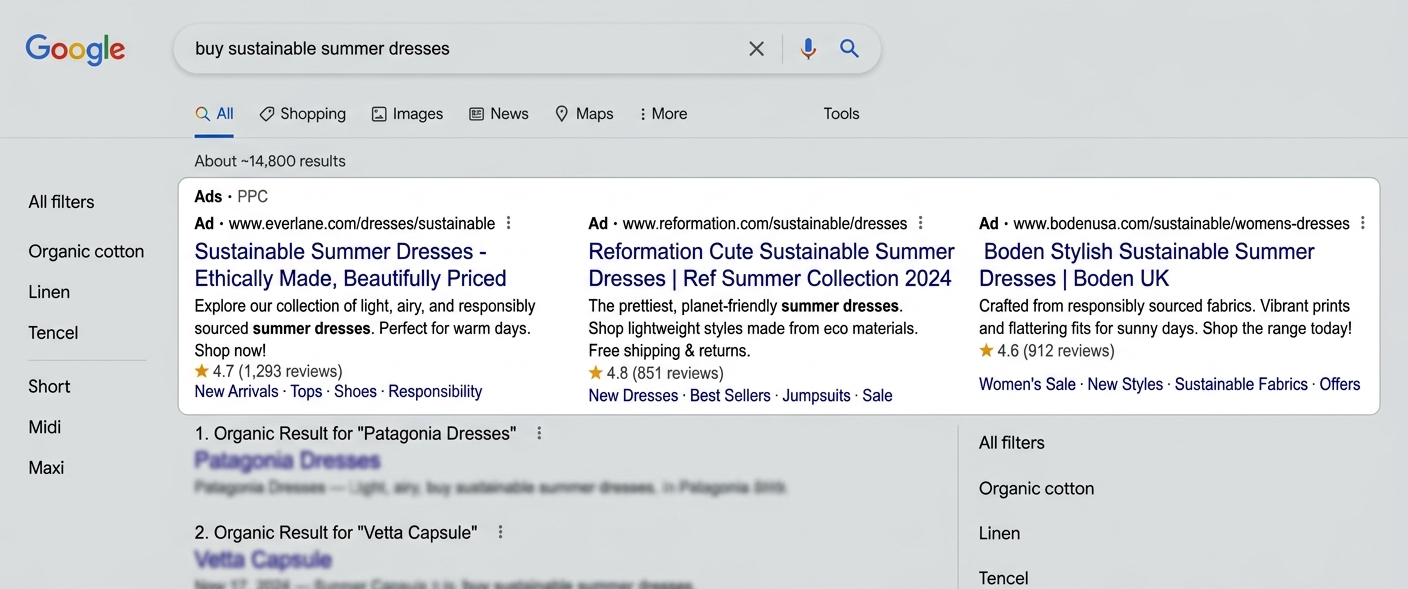
Google PPC Pay-Per-Click is an advertising model where you pay only when someone clicks your ad. Your ad can appear thousands of times in Google search results without costing you anything. You are charged only at the moment of the click.
This is what makes PPC fundamentally different from traditional advertising models. A newspaper ad or billboard charges for exposure regardless of whether anyone acts on it. Google PPC charges for intent if someone saw your ad, found it relevant enough to their search, and chose to click through to learn more.
The mechanics work through an auction. Every time a search is entered on Google, an automated auction runs in milliseconds. Your Ad Rank the position your ad receives is determined by multiplying your bid by your Quality Score. Quality Score is Google's measure of how relevant your ad and landing page are to the search query. This means a highly relevant ad with a lower bid can outrank a higher bid with poor relevance, and will cost less per click in the process.
This is the foundational insight most self-managed campaigns miss: Google PPC rewards relevance, not just spending power. A business with a ฿15,000 monthly budget and tightly structured, relevant campaigns will consistently outperform a competitor spending ฿50,000 on poorly matched broad keywords.
Google PPC services specifically manage this system structuring campaigns to maximise relevance, Quality Score, and conversion outcomes as distinct from Google Display advertising (which charges per thousand impressions and operates on an awareness model rather than intent capture).
Why most Google Ads campaigns fail to convert
Traffic is sent to the homepage, not a landing page

A homepage is designed to introduce an entire business. A landing page is designed to convert a specific type of visitor arriving from a specific search query. When someone in Bangkok searches "เปิดบัญชีภาษีนิติบุคคล" and your ad takes them to your accounting firm's homepage where they are greeted by your team photo, your service list, and a rotating banner the message mismatch causes them to leave within seconds. Every campaign should have a dedicated landing page that mirrors the ad's promise and moves the visitor toward one clear action.
Ad copy and landing page messaging do not match
If your ad headline says "Fast Company Registration in Bangkok" and your landing page headline says "Professional Business Solutions for Growing Companies," the visitor experiences a disconnect. Google measures this it is part of your Quality Score and so does your conversion rate. The headline a visitor clicks on should be the first thing they see when they arrive.
Mobile page speed is too slow
Mobile internet penetration exceeds 90% and the majority of Google searches are conducted on mobile devices. A landing page that loads in more than three seconds on a mobile connection loses a significant proportion of its traffic before the page even renders. This is measurable in Google Analytics and fixable but most campaigns run for months on slow pages without anyone flagging it.
Conversion tracking is not set up correctly
If your campaign cannot tell Google which clicks led to a form submission, a phone call, or a Line OA message, the platform's automated bidding has no signal to optimize against. It will optimize for clicks which is not what you are paying for. Correctly configured conversion tracking, verified through Google Tag Manager or direct code implementation, is the prerequisite for any meaningful campaign performance.
Keyword intent is mismatched
Informational queries ("what is Google Ads") and transactional queries ("Google Ads agency Bangkok") require different campaigns, different ad copy, and different landing pages. Mixing them in the same ad group dilutes relevance and wastes budget on visitors who are researching, not buying.
The anatomy of a Google Ads campaign that converts: 6 elements that matter most
- Keyword intent match. Every keyword in your account should be classified by intent stage informational, navigational, or transactional. Transactional keywords ("hire Google Ads agency Bangkok," "Google Ads management services Thailand") go into conversion-focused campaigns with direct CTAs and pricing information. Informational keywords, if targeted at all, go into separate awareness campaigns with different objectives and different landing pages.
- Ad copy relevance. The keyword someone searched, the headline they see in your ad, and the first line of your landing page should form a coherent, consistent message. Each ad group should contain two to three Responsive Search Ad variants with different headline combinations being tested. The agency monitors which combinations produce the highest CTR and conversion rate and retires underperformers monthly.
- Landing page alignment. A converting landing page has one job: take the specific visitor arriving from a specific ad and move them toward one action. It should include the primary keyword in the headline, a clear value proposition above the fold, trust signals relevant to a Thai audience (business registration number, Google reviews, real team photos, Line OA contact button), and a single, prominent CTA. Remove the navigation menu giving visitors fifteen other pages to click to is giving them fifteen reasons not to convert.
- Conversion tracking. Every campaign should track at minimum: form submissions, phone calls (via Google call tracking or a tracking number), and Line OA link clicks. For ecommerce, purchase completions and revenue values should be passed to Google Ads so ROAS bidding can be used. Conversion tracking should be verified not assumed before a campaign goes live. Check the Conversions column in Google Ads and confirm the tracking status shows "Recording conversions."
- Bid strategy selection. The right bid strategy depends on how much conversion data the account has accumulated. A new campaign with fewer than 30 conversions per month should run on Manual CPC or Maximise Clicks while data builds. Once conversion volume is sufficient, Target CPA or Maximise Conversions bidding uses Google's machine learning to shift budget toward the clicks most likely to convert based on historical patterns. Moving to automated bidding too early before the algorithm has enough data is one of the most common causes of wasted spend in Thai Google Ads accounts.
- Ad extensions
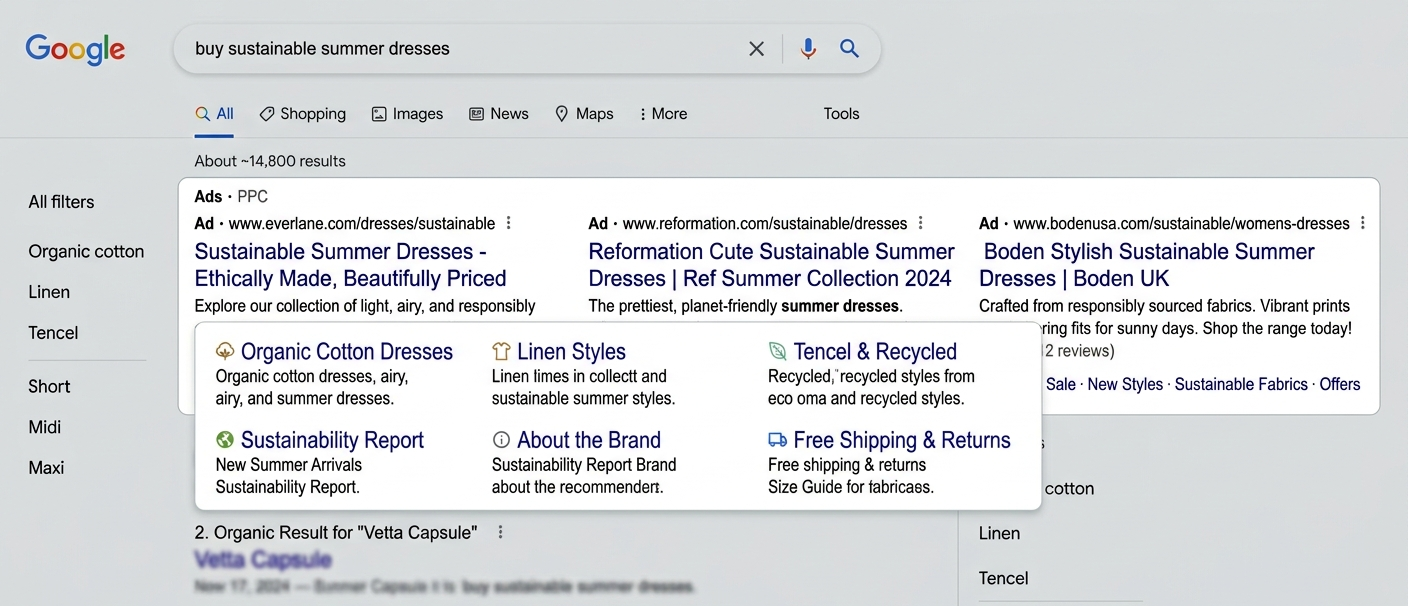
Sitelink extensions, callout extensions, call extensions, and location extensions are free additions that increase ad size, improve CTR, and provide additional paths to conversion. A properly managed Google Ads account uses all relevant extensions on every campaign. Their absence is a reliable indicator that the account has not been actively managed since setup.
Google PPC for ecommerce vs. service businesses: what changes and why
The campaign structure, conversion types, and bid strategies that work for a Bangkok-based ecommerce store are fundamentally different from those that work for a professional services firm, clinic, or agency. Running the same setup for both is a common agency mistake.
Service businesses agencies, clinics, law firms, logistics companies, schools, consultants run Search campaigns targeting high-intent transactional queries. Their conversions are form submissions, phone calls, and Line OA messages. Their landing pages are designed to establish credibility and lower the barrier to making first contact. The key metric is Cost Per Lead (CPL) and ultimately Cost Per Acquired Client. Bid strategies target CPA once sufficient conversion data exists. Average sales cycles are longer, so attribution windows should be extended to 30–90 days.
Ecommerce businesses run a different stack. Google Shopping campaigns, fed by a clean and well-structured Google Merchant Center product feed, display product images and prices directly in search results capturing buyers at the point of purchase intent. Performance Max campaigns run across all Google inventory and optimise for purchase conversions and ROAS (Return on Ad Spend). The key metrics are ROAS, Cost Per Purchase, and Average Order Value. Landing pages are product pages or category pages, not lead-capture pages. Conversion tracking must pass revenue values to Google, not just conversion counts, for ROAS bidding to function correctly.
An ecommerce ad agency that understands this distinction will build separate campaign types for each business model. One that defaults every client to the same Search campaign structure regardless of business type is not optimising for your actual conversion mechanics.
Key metrics every Thai business owner should understand in their Google Ads reports
Understanding these metrics means you can hold any Google Ads service agency accountable regardless of how their report is presented.
Impressions tell you how many times your ad was shown. A vanity metric on its own useful only in context of other numbers.
Click-Through Rate (CTR) measures the percentage of impressions that result in a click. A healthy CTR for Search campaigns is typically 3–8%. Below 2% suggests ad copy or keyword relevance needs attention.
Cost Per Click (CPC) is the average amount paid per click. Varies significantly by industry in Thailand from ฿5–฿30 for ecommerce keywords to ฿50–฿200+ for financial services and real estate.
Conversions are the actions that matter: form submissions, calls, Line OA clicks, purchases. If this column is empty or zero in your report, either conversion tracking is broken or the campaign is not generating results.
Cost Per Conversion (CPA) is total spend divided by total conversions. This is your real KPI. A campaign spending ฿20,000 per month generating 40 leads has a ฿500 CPA. Whether that is good or poor depends entirely on the value of a customer to your business.
Conversion Rate is the percentage of clicks that become conversions. For service business landing pages, a conversion rate of 2–5% is typical. Below 1% points to a landing page problem not a Google Ads problem.
Quality Score is Google's 1–10 rating of your keyword's expected CTR, ad relevance, and landing page experience. A Quality Score of 7 or above means you are paying less per click than competitors with lower scores. Below 5 means you are paying a premium for each click. Improving Quality Score is one of the highest-leverage optimisation activities in any account.
If your agency's monthly report contains impressions and CTR but no conversions, CPA, or Conversion Rate ask why. The answer will tell you a great deal about how your account is actually being managed.