
How to Structure a Website for Long-Term Business Growth That Actually Works

Many businesses start building a website with a simple goal: to have an online presence where customers can find them and get in touch. Over time, as the business adds new services, grows its team, and invests more in marketing, the original website often becomes a limitation. Managing content becomes harder, SEO performance starts to stall, and connecting the site with marketing tools or business systems feels complicated. What once felt good enough turns into something that needs constant fixing, costing both time and budget.
Planning a strong website structure from the beginning is not only about visual design. It is about thinking like a business owner and asking what role the website should play one year, two years, or even five years from now. This article walks you through how to structure a website that supports long-term growth, helping your site become more than just an online storefront and instead a practical tool that drives sustainable business expansion.
Why Website Structure Matters for Business Growth
Website structure is how you communicate to both customers and search engines like Google what your business does, what you specialize in, and where people should start exploring. From a customer’s perspective, a clear structure shortens the decision-making process. When visitors can understand your services or products within just a few clicks, trust builds faster. The website clearly shows who the expert is and how to make contact, which directly impacts inquiry rates and long-term sales opportunities.
From a business perspective, a well-organized structure makes internal workflows easier. Marketing teams can add new content or campaign pages without breaking the site. Sales teams can share specific service pages with prospects. IT teams can connect the website to CRM platforms and analytics tools more smoothly. If the foundation is not built to scale, every new feature or system integration turns into a major and costly redevelopment.
For SEO, website structure is the backbone of long-term authority. Clear content categories, strong internal linking, and well-defined page priorities help Google understand which pages represent the core topics of your business. Over time, this strengthens your domain and improves your ability to rank consistently for relevant keywords. That is why a solid structure is not optional for sustainable SEO growth.
What a Strong Website Structure Should Consider
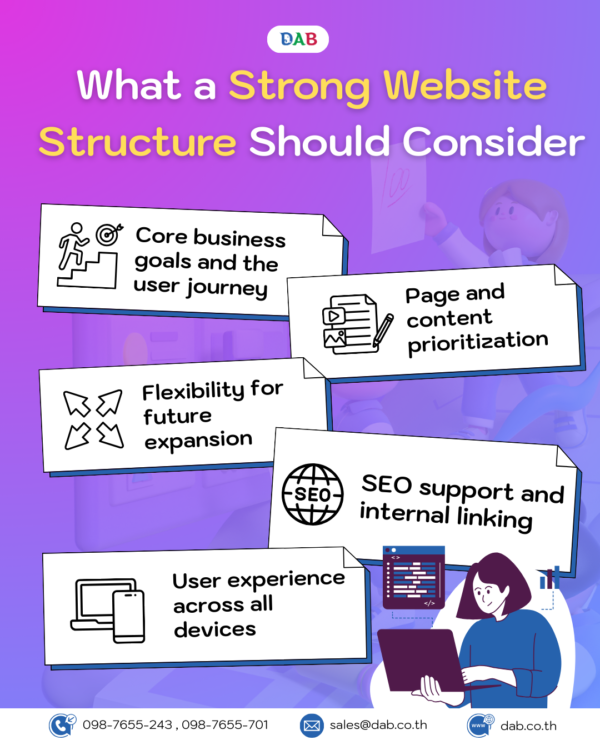
- Core business goals and the user journey
Before thinking about menus or the number of pages, start with one key question: what should visitors do next after they land on your website. Some businesses want users to submit a contact form. Others want them to review a portfolio or make a purchase right away. A strong structure guides visitors naturally from the homepage to the point of conversion without forcing them to think or click more than necessary.
- Page and content prioritization
Not every page carries the same weight. Main service pages, core product pages, or revenue-generating pages should be the easiest to access from the main menu or homepage. Supporting content such as blog articles, resources, or news should be clearly categorized. This helps both users and search engines understand what your business focuses on most.
- Flexibility for future expansion
Growing businesses often add new services, target new customer segments, or enter new markets. A scalable website structure leaves room for these changes from the start. This could mean setting up broad service categories that can support new subpages later, or building a content system that can grow into a full knowledge hub without needing a complete rebuild.
- SEO support and internal linking
Readable URLs, clear content categories, and logical internal links help your website build long-term strength. Instead of each page working in isolation, every page supports the others by sharing relevance, authority, and visibility in search results. This improves both Google rankings and overall site credibility.
- User experience across all devices
A strong structure must work just as well on mobile phones and tablets as it does on desktop screens. Menus should stay simple, content should be easy to read, and key actions should always be visible. This directly affects how long users stay on your site and how likely they are to reach out or convert.
- Backend systems and internal management
A website is not only for customers. Your internal team needs to update content, create new pages, and adjust information easily. A well-structured backend reduces dependence on technical teams for every small change and allows marketing and sales teams to respond faster to new business opportunities.
Why Choosing the Right Agency Is Linked to Website Structure
Many businesses choose a web agency based mainly on price or visual design. In reality, the real difference between a website that simply functions and one that grows with your business lies in the thinking behind the structure from day one. This reflects the true level of expertise an agency brings to the project.
Experienced agencies start by understanding your business model, target audience, marketing goals, and long-term growth plans. They translate these insights into a website structure that supports both customer communication and internal operations. This includes how service categories are organized, how pages are prioritized, and how user journeys align with your real sales process.
From an SEO agency and digital marketing perspective, agencies with a strategic mindset plan ahead for URL structure, keyword grouping, and content connections. This allows your website to build authority over time, not just rank for a short period, and to expand its content ecosystem without needing constant structural changes.
Conclusion
A strong website structure is not about choosing a beautiful template or adding more features. It comes from viewing your website as part of your long-term business strategy, from customer communication and marketing to service expansion and internal systems.
When your structure is built with intention, your website becomes more than an information page. It turns into a central platform that connects trust-building content, SEO-driven traffic, and real sales opportunities.
For businesses focused on sustainable growth, investing in the right website structure from the beginning reduces future costs and increases flexibility as markets and customer behavior change. If you want a website that supports not only today’s needs but also your long-term business vision, working with an agency that understands both technical execution and digital strategy will help you build a solid and scalable foundation.