

Ready-Made Website vs Custom Business Website: Key Differences You Should Know

Building a website for your business today is no longer just about having a place where customers can read information or view your services. It is about creating a central system for marketing, sales, and communication across every digital channel, from online advertising and Google search visibility to internal data management for your team.
Many companies begin with a ready-made website or a template-based site because it allows them to go live quickly and manage their initial budget more easily. However, as the business grows, adds more services, targets multiple customer segments, or starts relying more heavily on SEO and digital marketing systems, a key question often follows can the current website structure still support this level of growth?
This article helps you understand the differences between a pre-built website structure and a business website designed around your specific processes. It looks at real-world usage, long-term cost, and system scalability, so choosing a website becomes a strategic decision rather than just a design choice.
What Is a Ready-Made Website and What Type of Business Is It Best For
A ready-made website, often referred to as a website template or pre-built website, is created using a structure and design that has already been developed in advance. Users select a theme, choose page layouts, and adjust text, logos, and brand colors to match their business. This allows the site to go live without building the entire structure from the ground up.
These systems are commonly built on platforms such as WordPress, website builders, or CMS platforms that offer a wide range of themes and plugins. This makes it possible for businesses to launch a website in a short time frame and keep initial costs under control.
From a structural perspective, a ready-made website operates within a predefined framework. This includes menu layouts, service pages, about pages, and contact forms that follow a standard format. This approach works well for businesses with simple service structures and limited need to connect with back-office systems or advanced marketing tools.
Practical Advantages of Ready-Made Websites
For small businesses or companies testing a new market, ready-made websites often provide speed and ease of use. Teams can update content, publish blog posts, or change images without depending on developers for every adjustment.
From an SEO perspective, many modern templates support basic configuration for meta data, URLs, and search plugins. This makes them suitable for foundational content marketing and ranking for general keywords on Google.
Common Limitations as the Business Grows
As a website expands to support multiple languages, multiple services, or integrations with CRM systems, sales platforms, or advanced advertising tools, the limitations of a template-based structure often become more visible. Common challenges include:
- Difficulty adjusting URL structures or creating campaign-specific landing pages
- Slower site performance as more plugins are added
- Limited ability to design user flows that match the company’s actual sales process
At this stage, many businesses begin to explore the option of a website designed and developed around their specific business processes. This allows the website to function not just as an online presence, but as a connected system that supports marketing, sales, and data management in one platform.
What Is a Custom Business Website and How Is It Structurally Different
A custom business website is built by starting with an analysis of the company’s business model rather than selecting an existing theme. The goal is not simply to create a visually appealing site, but to design a digital system that connects marketing, sales, and internal data management within a single platform.
The development process typically begins by mapping the customer journey, from Google search and website entry to contacting the sales team and completing a transaction or submitting business information. Page structures, menus, form systems, and databases are then designed to support these workflows directly, rather than being constrained by a template or pre-built plugin framework.
1.Structure Designed for Long-Term SEO and Marketing
One of the key differences lies in how the site architecture is planned from the beginning. This includes URL structures, service category organization, landing pages for advertising campaigns, and internal linking between articles and service pages. This approach allows SEO and content expansion to follow a single, consistent system, without requiring major structural changes each time the business adds new services or adjusts its marketing strategy.
2.Integration with Business Systems and Tools
Custom Ecommerce websites are often developed to connect directly with systems such as CRM platforms, customer management systems, sales dashboards, and advertising platforms. Data from contact forms and user behavior can be routed automatically to sales and marketing teams, turning the website into an active part of the company’s internal workflow rather than just a communication channel.
3.Flexibility as the Business Expands or Changes
When a company launches new business lines, enters new markets, or adds multilingual support, a custom structure allows new modules and systems to be integrated into the existing website without rebuilding everything from scratch. This could include adding customer portals, membership systems, or booking and payment platforms that connect to the same database and operational framework.
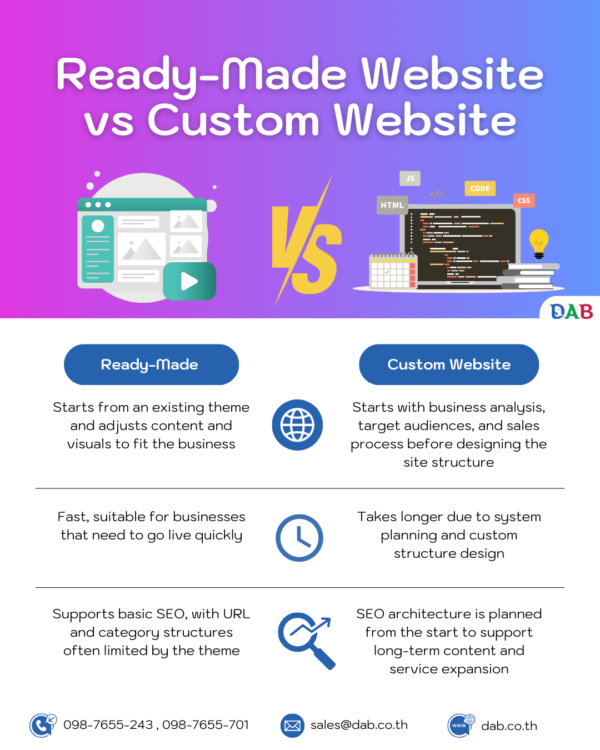
Comparison Table: Ready-Made Website vs Custom Business Website
| Comparison Area | Ready-Made Website (Template-Based Site) | Custom Business Website (Business-Specific Design) |
| Design Approach | Starts from an existing theme and adjusts content and visuals to fit the business | Starts with business analysis, target audiences, and sales process before designing the site structure |
| Time to Launch | Fast, suitable for businesses that need to go live quickly | Takes longer due to system planning and custom structure design |
| Structural Flexibility | Limited by the theme and plugin framework | Menus, systems, and functions can evolve with business growth |
| SEO Support | Supports basic SEO, with URL and category structures often limited by the theme | SEO architecture is planned from the start to support long-term content and service expansion |
| Marketing System Integration | Primarily relies on plugins and third-party tools | Designed to connect directly with CRM, sales systems, and advertising platforms |
| Initial Cost | Lower, suitable for limited budgets | Higher, due to analysis and custom development |
| Long-Term Cost Control | May increase when major structural changes or migrations are needed | More predictable, as the structure supports ongoing expansion |
| Business Scalability | Best for small businesses or short-term projects | Designed for companies planning to expand services, markets, or internal systems |
| Brand Positioning | Follows common market design patterns | Builds brand identity through unique structure and user experience |
Why Businesses Planning for Long-Term Growth Choose Custom Websites Over Templates
- Website Structure Aligned with the Sales Process
Custom websites are built by analyzing the customer journey from search and homepage entry to inquiry or quotation. Menus, page layouts, and calls to action are structured around how customers make decisions, rather than following a predefined theme layout.
- Long-Term SEO and Content Scalability
Instead of adding content as an afterthought, a custom website organizes categories, internal links, and navigation paths from the start. This supports structured SEO growth, campaign landing pages, and content expansion without requiring a full site rebuild.
- Unified Marketing and Sales System Integration
Custom platforms can connect directly to CRM systems, lead tracking tools, quotation forms, and advertising platforms. This allows website data to flow directly into sales and marketing operations for performance tracking and follow-up.
- Functional Expansion Without Structural Disruption
As new services, markets, or internal systems are added, custom websites can integrate new modules without changing the core structure, reducing the risk of system limitations as the business grows.
- Distinct Brand Identity in a Competitive Market
Rather than using layouts similar to hundreds of other websites, a custom platform reflects the brand through its structure, user experience, and information flow. This helps customers recognize the business by how the website works, not just how it looks.
- Better Long-Term Cost Management
While the initial investment is higher, custom websites reduce future costs related to theme changes, system migrations, and major structural modifications. This aligns website investment with long-term business planning.
Summary: Choosing a Website Structure That Supports Business Growth
There is no single “best” option for every business. The difference between a ready-made website and a custom business website lies in flexibility and long-term direction. If the goal is fast deployment, limited budget, and basic information delivery, a template-based website remains a practical choice.
For businesses that rely on SEO, digital marketing, and structured sales processes, investing in a custom website allows systems, structure, and user experience to scale alongside the organization. It reduces limitations in service expansion, back-office integration, and future campaign development.
Ultimately, choosing a website structure should be treated as a strategic decision. It is not just about design or price, but about building a digital business platform that supports marketing, sales, and operational growth over the long term.
If you are planning a website that supports SEO, digital marketing, and long-term business growth, our team is ready to help you design the right structure for your goals. Contact us to start your project today.
Frequently Asked Questions (FAQ)
- What type of business is best suited for a ready-made website
Small businesses or startups that need a basic online presence for services, contact details, and company profiles, without relying heavily on SEO or digital marketing systems.
- Is a custom website necessary for every business
Not in all cases. It is most valuable for businesses that use their website as a primary lead generation tool or need integration with back-office systems such as CRM, sales platforms, or marketing automation tools.
- Can a template-based website support SEO
Yes, to a basic level. However, structural limitations often affect technical SEO, site speed optimization, and long-term keyword-focused page architecture.
- What is the long-term cost difference between ready-made and custom websites
Template-based sites usually have lower initial costs but may require higher investment later for restructuring, migrations, or system changes. Custom websites have higher upfront costs but support long-term expansion more efficiently.
- Can a business start with a template and switch to a custom website later
Yes, but businesses should consider the time and cost involved in migrating content, SEO structure, and internal systems. In many cases, this can be close to the effort required to build a new website.
- How does a custom website support digital marketing
It allows structured page design based on the customer journey, supports analytics tools, and enables the creation of campaign-specific landing pages with greater flexibility.
- What website structure is best for B2B companies
B2B businesses with multiple services, customer segments, and complex sales processes typically benefit from custom websites that align content and functionality with decision-making workflows.
- How long does it take to develop a custom business website
This depends on the size and complexity of the system. Development can range from a few weeks to several months, especially when UX design, SEO architecture, and back-office integration are involved.
- What should be the main consideration before choosing between a template and a custom website
Businesses should focus on their growth plan over the next one to three years, the role of the website in sales and marketing, and the need for system integration rather than just the initial cost.