

Common Website Mistakes That Force a Redesign Within One Year

Many businesses create a new website expecting it to support their growth for years. Yet, in less than twelve months, they often start hearing comments like “this needs to be fixed” or “we should redesign the whole site” from marketing teams, sales staff, or even customers. These signals usually do not come from poor visual design, but from a structure and planning approach that does not align with how the business actually operates.
As a website begins to play a bigger role in lead generation, brand credibility, and marketing system integration, small limitations that were overlooked on day one gradually turn into major obstacles. This article walks you through the most common website mistakes that force many businesses to redesign within their first year, along with practical ideas to avoid these issues from the start so your website can grow alongside your business with confidence.
Common Misconceptions Before Starting a Website
One of the most common misconceptions is seeing a website as nothing more than an online brochure. Many businesses focus on having an “About” page and a “Contact” page without thinking about how the website supports the customer decision journey. When it is time to launch campaigns or create content to attract traffic, a site built on a basic structure often struggles to scale smoothly.
Another frequent mistake is prioritizing visual appeal above everything else, assuming that an eye-catching design will solve all problems. In reality, a website that looks great but is difficult to navigate or slow to load often causes visitors to leave before they truly understand the business. This directly affects both user experience and long-term marketing performance.
Many businesses also delay SEO and backend planning, believing these can be added later. As the website grows with more pages and content, restructuring it to support search visibility and content management becomes a major project instead of a small, strategic adjustment.
These misconceptions rarely come from poor decisions, but from a lack of long-term perspective on the role a website should play. Starting with a strategic mindset helps businesses avoid early redesigns and ensures that every investment in the website delivers ongoing and measurable value.
Website Mistakes That Force an Early Redesign
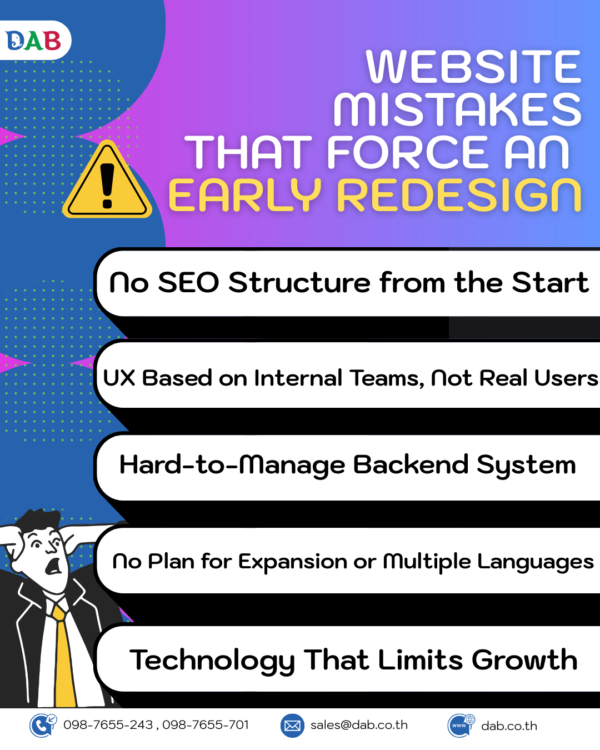
1.Building the website structure without SEO in mind from the beginning
Many websites are designed purely for visual presentation without considering how search engines read and interpret content. When URLs are unclear, content categories are inconsistent, and internal links between related pages are missing, the site struggles to generate organic search traffic. Once a business decides to invest seriously in content marketing or SEO, it often needs to restructure the entire site to support long-term growth.
2.Designing user experience from the business owner’s perspective instead of real users
A menu that feels intuitive for an internal team may not make sense to potential customers. Organizing content based on internal departments rather than user needs makes it harder for visitors to find key information or take action. The result is higher bounce rates and a growing perception that the website is not helping generate real business opportunities.
3.Using a backend system that is difficult to manage and scale
Some websites start on platforms that seem simple at first, but become restrictive when marketing teams need to publish articles, launch campaign pages, or update content frequently. Relying on technical support for every small change slows down execution and causes missed marketing opportunities, often leading businesses to redesign or migrate to a new system for better flexibility.
4.Not planning for service expansion or multiple languages
As businesses grow, adding new services or entering international markets becomes a natural step. Websites that were not structured for expansion face challenges in organizing pages, managing language versions, or reordering content. What should be a simple page addition often turns into a full structural overhaul.
5.Choosing technology that does not support long-term growth
Selecting a platform based on familiarity or low initial cost can limit future integration with systems like CRM tools, email platforms, or analytics solutions. When technology becomes a barrier instead of a foundation, a full website redesign often becomes the only viable option.
6.Lack of tracking and marketing tool integration
Websites that launch without analytics and user behavior tracking leave businesses without reliable data for decision-making. When you do not know where visitors come from, which pages they engage with, or where they drop off, website improvements become guesswork rather than data-driven optimization. This often results in major redesigns instead of continuous, strategic improvements.
Business Impact of Frequent Website Redesigns
- Development costs continue to rise. Every redesign introduces new expenses for design, development, testing, and backend adjustments. Budgets that could be allocated to marketing or business expansion are repeatedly redirected toward rebuilding the website.
- SEO performance and organic traffic become unstable. Frequent changes to page structure and URLs can cause search rankings to fluctuate. Pages that once performed well may temporarily disappear from search results, reducing traffic and sales opportunities during transition periods.
- Internal teams lose time and productivity. Marketing and sales teams must relearn systems every time the website changes. Time that should be spent generating leads and creating content is instead used adapting to new platforms and workflows.
- Brand consistency suffers. A website that changes its structure and appearance too often can make a brand appear unstable, especially in industries that depend heavily on trust, such as enterprise services or long-term partnerships.
- Marketing campaigns become harder to track. When website structures change, links from ads, email campaigns, and social media may lose effectiveness. Inconsistent data makes it difficult to analyze long-term campaign performance.
- Business opportunities are lost during transitions. While a website is being redesigned, functionality may be limited. Potential customers may struggle to find information or make contact, leading to missed sales and relationship-building opportunities.
How to Avoid These Mistakes from Day One
1.Start with clear business goals before designing the website
Instead of focusing on appearance and features, begin by defining what the website should achieve, such as increasing sales inquiries, building credibility, or supporting lead generation. These goals guide the site structure and user journey from the start.
2.Plan SEO and content structure alongside the design process
Page categories, URL structure, and content planning should be developed together with visual design, not added later. This ensures the website is ready to generate organic traffic and reduces the need for major restructuring in the future.
3.Choose technology and platforms that support long-term scalability
The backend should be easy for marketing and sales teams to manage, allow seamless content expansion, support analytics integration, and handle service growth or multilingual setups without requiring a full rebuild.
4.Test user experience from real customer perspectives
Before launch, have people outside the project test the site, from finding information to submitting inquiries or making purchases. Real user feedback often reveals friction points internal teams may overlook.
5.Work with an agency that acts as a strategic partner, not just a website provider
A professional agency helps ask the right strategic questions, align website structure with business goals, and plan for long-term development instead of simply delivering a finished site. If you are looking for a team that offers strategic consultation and helps build a strong digital foundation from day one, Digital Agency Bangkok provides free consultations to evaluate your direction and design a website structure that grows with your business.
Conclusion
Needing to redesign a website within a single year rarely comes from one major mistake. It is usually the result of small early decisions made without a long-term business perspective, from SEO structure and backend systems to overall user experience. When these foundations are weak, the website becomes a limitation rather than a growth engine. For businesses that want a website capable of scaling with long-term goals, consulting with experienced professionals from the beginning is a practical first step toward building a stable digital foundation for future expansion.