



WordPress or Laravel: When a Thai Business Should Stay, and When to Commission a Custom App

A Thai business does not pick WordPress or Laravel because one stack looks newer. It picks the tool it can still run in three years: who maintains it, who edits the words, who you hire when something breaks, and which integrations you operate. It invents no fee, no timeline, and no score. Commissioning the application sits on our custom web application page. This article does not set a price.
Short answer: Stay on WordPress when the job is pages, offers, and content a person on your team can change. Commission a custom application when the product is a workflow: logins, roles, rules, and state a page cannot hold. The two can sit side by side. If you are still choosing public URLs, start with how many pages a Thai business website needs. If those pages will be heavy on a phone, read Core Web Vitals and INP on a Thai mobile page first. Those notes may not be public yet. This page does not edit them.
The decision is three years of operations
A stack choice looks like a build. The cost you feel comes later: a rule change, a person leaving, and a project nobody can open. If a proposal cannot name who owns hosting, who can publish a sentence, and what happens when an integration changes, it is a demo.
A person who can fix a phone number in the editor should not need a developer for that sentence. A booking rule or a member permission is not a blog post. Putting it in a page builder only moves the cost into breakage. Name the job first. Offers and a form you answer are a site. Holding a unit and changing a calendar is an application. Both is two jobs. Do not pick Laravel to impress a pitch, or stay on a theme only because the last vendor still has the login.
Stay on WordPress when the job is content
Stay when the visitor reads and takes a next step you already answer: a call, a LINE, a form, a map. A company site, a clinic note, a hotel description, a project page, a menu, a bilingual article. If a named person can change a heading, an hour, or a sold-out line without opening code, the editor is the product.
A form, a language pair, a cache, and a backup are ordinary maintenance. Leave only when a plugin stands in for software you should own: a private workflow, or a rule no setting screen can express.
What the editor may own
The editor owns copy, menus, and the language pair. They do not own payment logic, inventory truth, or who may see a record. If the weekly work is a sentence or taking a page down, train the editor. If nobody will update the page, do not publish it. A theme that books and stores members is a website pretending to be an app. Keep public pages with the content people. Move the workflow to software with an owner.
Commission a custom app when the workflow is the product
Commission a custom application when people log in and change state. A reservation that must not double-book. A listing that leaves the market when it is sold. An order that moves through your process. A portal a client sees alone. A rule staff retype because a page cannot hold it.

Laravel is one common way to build that application. It is not the point. You need a codebase a hired team can change without fighting a theme: accounts, roles, a database you can explain, and a place for the integration. If the proposal is to click state into a page builder, you are buying the wrong shape. The service page says what a custom web application is. This note only says when to ask.
State needs a named owner
A page can show a number. It cannot be the source if two people change it at once, or if a second booking must be refused. State needs a record, a permission, and a named owner. If you cannot name that person, do not start. Many firms need both tools: an editable public site, and an application for the work the site should not fake. Do not rebuild the marketing site as an app because one workflow is custom. This note invents no page total.
Maintenance over three years
Maintenance is not bought once. On WordPress it is core, the theme, and plugins, on staging, with a backup you have opened. A custom application is framework updates, the server, and the same habit. A late update on a content site is often a form. On an application it can be the login or the calendar. You need a named owner and a restore you have practised. This page quotes no downtime and invents no host price.
Hiring, and what happens when someone leaves
WordPress lets a person write, translate, and publish. You still need someone technical when core, a plugin, or the host fails. You do not need that person for every sentence. A custom application reverses the ratio. Changing a booking rule is usually a developer’s job. Changing a headline should not be.
Ask who else can take the project. A normal WordPress site can be handed on. A custom app can too, if you hold the repository, the server, and a note of how it runs. If only one freelancer has the login, you have a person, not a stack. This page invents no salary and no day rate.
Content editing is its own cost
Someone still writes the Thai, checks the English, and takes down the offer that ended. WordPress makes that labour visible. A custom app that stores every label in code hides it until a release. If both audiences use a page, keep both true. Do not change live slugs, or existing Rank Math redirects, to tidy URLs. This article moves no live path. If those pages will be opened on a phone, use the vitals note.
Integrations carry the bill and the risk
LINE, a payment provider, a booking channel, stock, a CRM, an accounting export. Each is a credential and a callback that can change without asking the theme. A plugin may cover a common case. When it is not your rule, you are renting a mismatch. On a custom application you own the change when the other side changes its API. Ask who notices, and which system is the source of truth. Do not add an integration because a competitor shows one. If you already run the system, connect to it. Do not copy its database into the theme. This note names no provider fee.
Cost drivers, with no invented fee
We do not print a baht figure here. A price, if you need one, is a quote against a scoped job. These lines belong in a three-year conversation. None is a measured client result.
- What you host: pages and media, or an application with logins and a database.
- Who updates core, plugins or libraries, and the server, and whether staging exists first.
- Who can change a sentence, a menu, and a language pair without a developer.
- Who can change a rule, on staff or commissioned.
- Licences you rent, versus code you hold and can hand on.
- Each integration: the credential, who is called when the other side changes, and what the customer sees if it fails.
- What you still hold if the first builder leaves: access, the repository, and a restore you have opened.
If a proposal leads with a stack name and none of those lines, it is selling a tool. A quote is requested on the custom application page. This article copies no number from a form, invents none, and changes no slug.
A decision order for this quarter
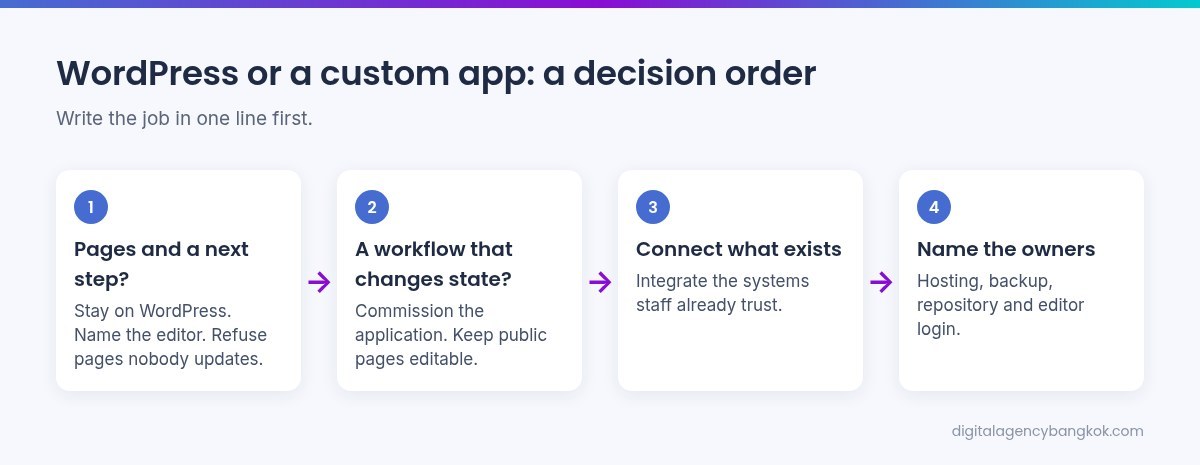
- Write the job in one line. Pages and a next step, or a workflow that changes state.
- If it is pages, stay on WordPress. Name the editor. Refuse pages nobody will update.
- If a theme or plugin is already the workflow, name the rule the page cannot hold. Do not add another plugin as the fix.
- If the job is state, commission the application. Keep the public pages editable unless they must move.
- Connect the systems you already operate. Do not rebuild a screen your staff already trust.
- Name the owner of hosting, the backup, the repository, and the editor login. One person holding all four is the risk to fix first.
- Check the public pages on a phone after the split. Slow templates belong with the Core Web Vitals note.
That order is the work. Commissioning the application sits on custom web application development. This page quotes no price and reports no client result.
FAQ
Should a Thai business pick Laravel because it is a newer stack?
No. Use Laravel, or another framework, when the product is a workflow a page cannot hold. If the job is pages a person can edit, stay on WordPress.
When should the site stay on WordPress?
When the weekly work is copy, a language pair, a menu, and a next step you already answer. Leave only when a plugin stands in for software you should own. This page sets no fee for staying.
When is a custom application the operations decision, not a redesign?
When people log in and change state, and a homepage redesign would not do that. Keep the brochure editable and commission the workflow beside it. This page claims no client result.
What actually drives the three-year cost?
Hosting, update labour, who can edit a sentence, who can change a rule, licences, integrations, and whether you still have access if the first builder leaves. None of those is a baht figure here. A quote belongs on the custom application page, against a scoped job.
Where is the price, and how is this different from the page-count and vitals notes?
Not here. We do not set a fee, a timeline, or a score. How many public pages the brochure needs is the page-count note. How those pages behave on a phone is the Core Web Vitals note. This page is the tool split: stay on WordPress for content you will edit, and commission a custom application when the workflow is the product.