


Why Your Business Isn’t Ranking Locally—and How Local SEO Can Fix It





Why Your Business Isn't Ranking Locally—and How Local SEO Can Fix It
If you type your own service into Google right now — "your service + your city" — and your business doesn't show up in the map pack or the first page, you're not alone. Thousands of businesses in Bangkok and across Thailand have solid products, real reviews from happy customers, and years of operating history, yet they're invisible to the exact customers searching for them right now. This isn't bad luck. It's almost always a fixable technical and strategic gap.
At Digital Agency Bangkok (DAB), we work with local businesses every week that assume their website "should" rank because it looks good and has decent content. Looking good isn't the same as being optimized. This article breaks down exactly why local businesses lose visibility, and the concrete steps that bring them back.
Local Search Is Not Optional Anymore
It's worth pausing on just how much weight local search carries before diving into the fixes. Nearly half of all Google searches now have local intent — people looking for a service, product, or business "near me" or in a specific neighborhood. For businesses that depend on foot traffic, phone calls, or local service bookings, this is the difference between a full calendar and an empty one.
What's changed in the past couple of years is that local search is no longer a single channel. It used to mean "rank in Google Maps." Now it means being visible across Google's map pack, Google's AI Overviews, Apple Maps, Bing Places, and increasingly, conversational AI tools like ChatGPT and Perplexity when someone asks for a recommendation. A business that only optimizes for the old-style "3-pack" and ignores everything else is optimizing for a shrinking slice of how people actually search today.
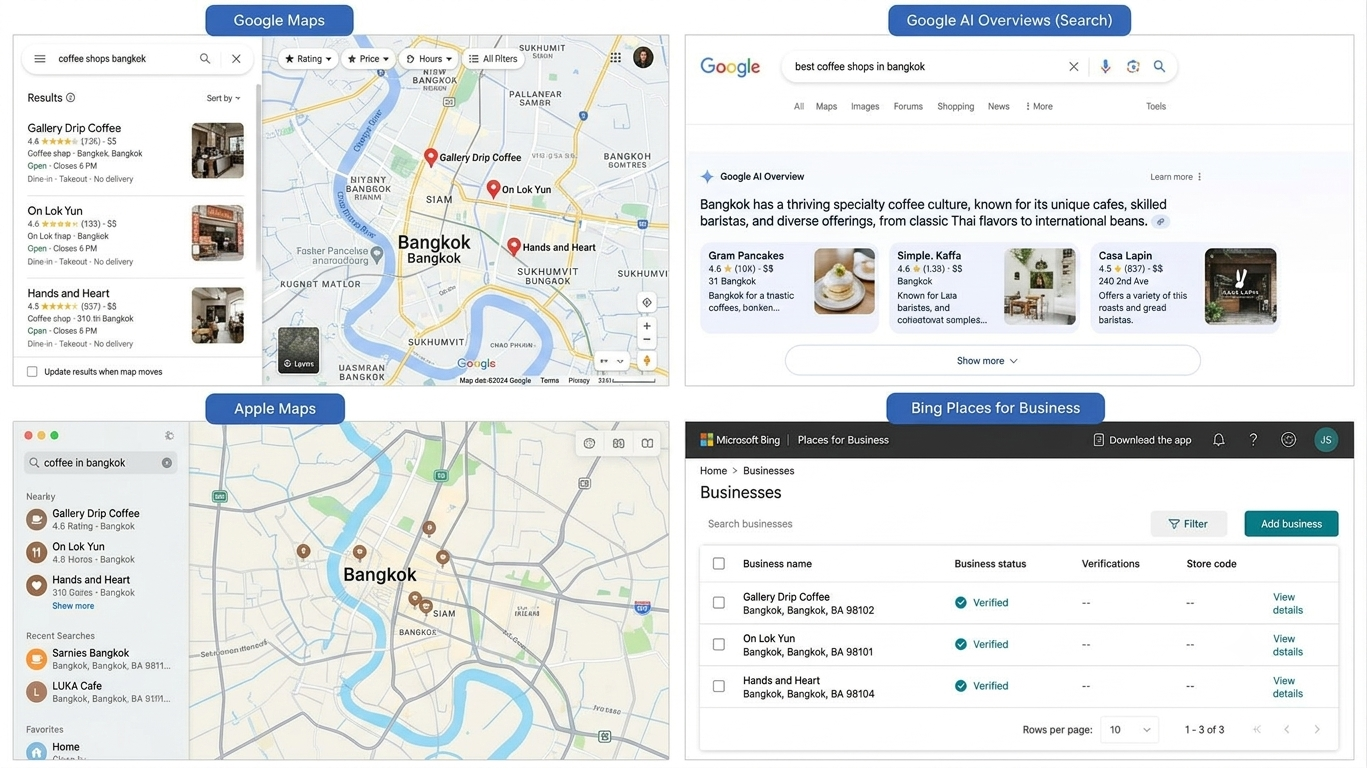
This is exactly why so many otherwise solid businesses in Bangkok feel invisible online — they built a website years ago, set up a Google listing once, and never touched either again. Meanwhile, the ranking criteria, the platforms, and customer search behavior have all moved forward.
Why Isn't Your Business Ranking Locally?
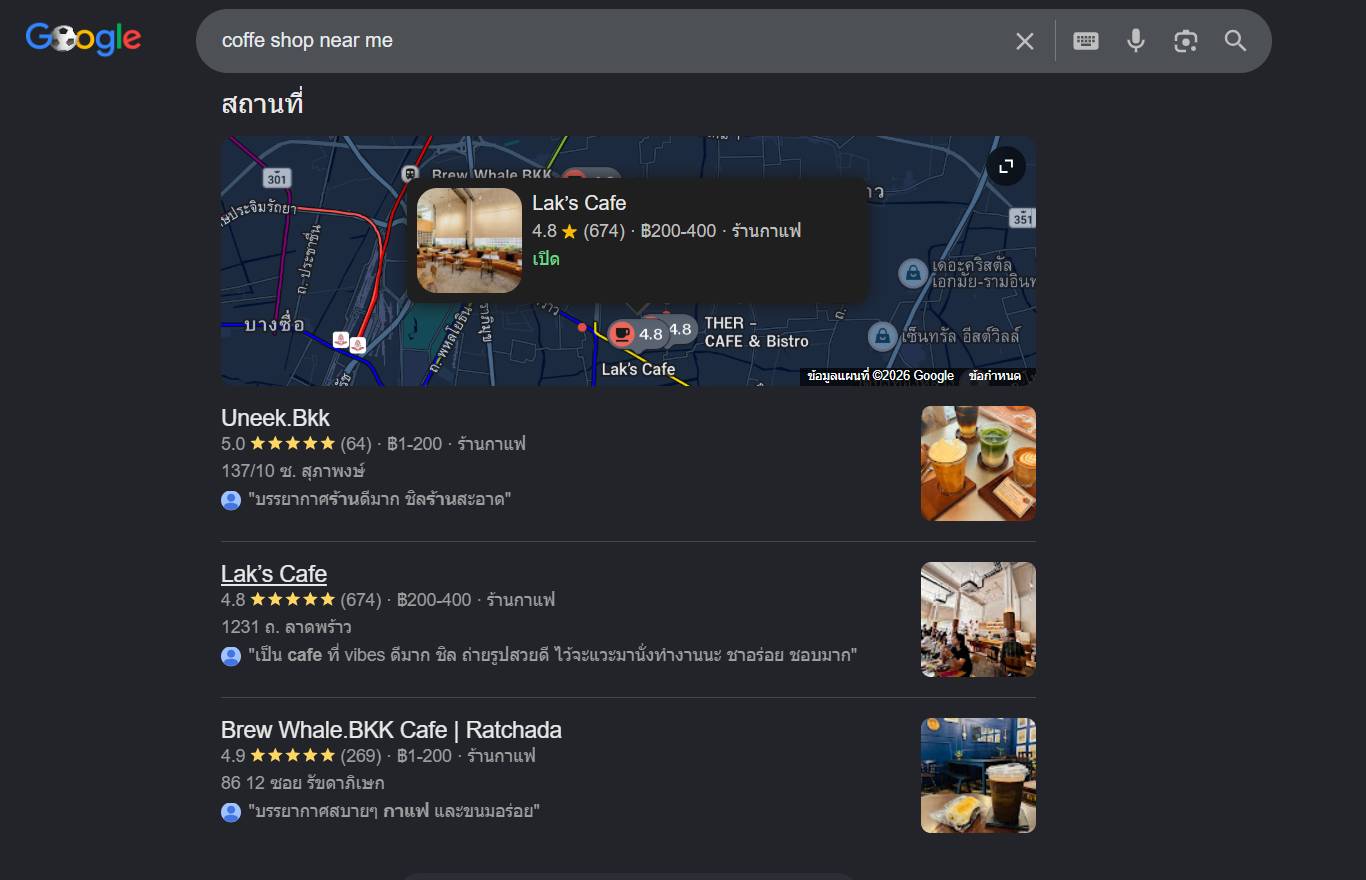
Local search results — the map pack (the "3-pack"), Google Maps rankings, and local organic listings — are driven by a different set of signals than standard organic SEO. According to current local search ranking research, the biggest weight sits with your Google Business Profile (GBP) signals, followed by on-page relevance, review signals, backlinks, and behavioral engagement. If any of these are weak or missing, you lose ground — even if your website itself is well built.
Here are the most common reasons local businesses in Bangkok don't rank:
1. An Incomplete or Inconsistent Google Business Profile
Your GBP is the single most important local ranking asset you own — more influential than your website in many local searches. Common mistakes we see:
- The business category doesn't match what customers are actually searching for
- No recent posts, photos, or updates ("profile looks abandoned" is a real signal Google picks up on)
- Business hours, phone number, or address don't match what's on your website
- Missing service area settings for businesses that serve customers beyond one address
Example: A boutique dental clinic in Thonglor had a GBP listed simply as "Dentist," with no mention of specific services like "Invisalign" or "teeth whitening Bangkok." After we rebuilt the profile with accurate categories, service attributes, and weekly photo updates, they began appearing in the map pack for four new high-intent search terms within six weeks.
2. NAP Inconsistency (Name, Address, Phone)
If your business name, address, and phone number are written differently across your website, Facebook page, Google Maps, and directory listings (even something as small as "Rd." vs "Road" or a missing suite number), search engines lose confidence in which listing is authoritative. This directly suppresses local ranking.
3. Not Enough Local, Relevant Reviews
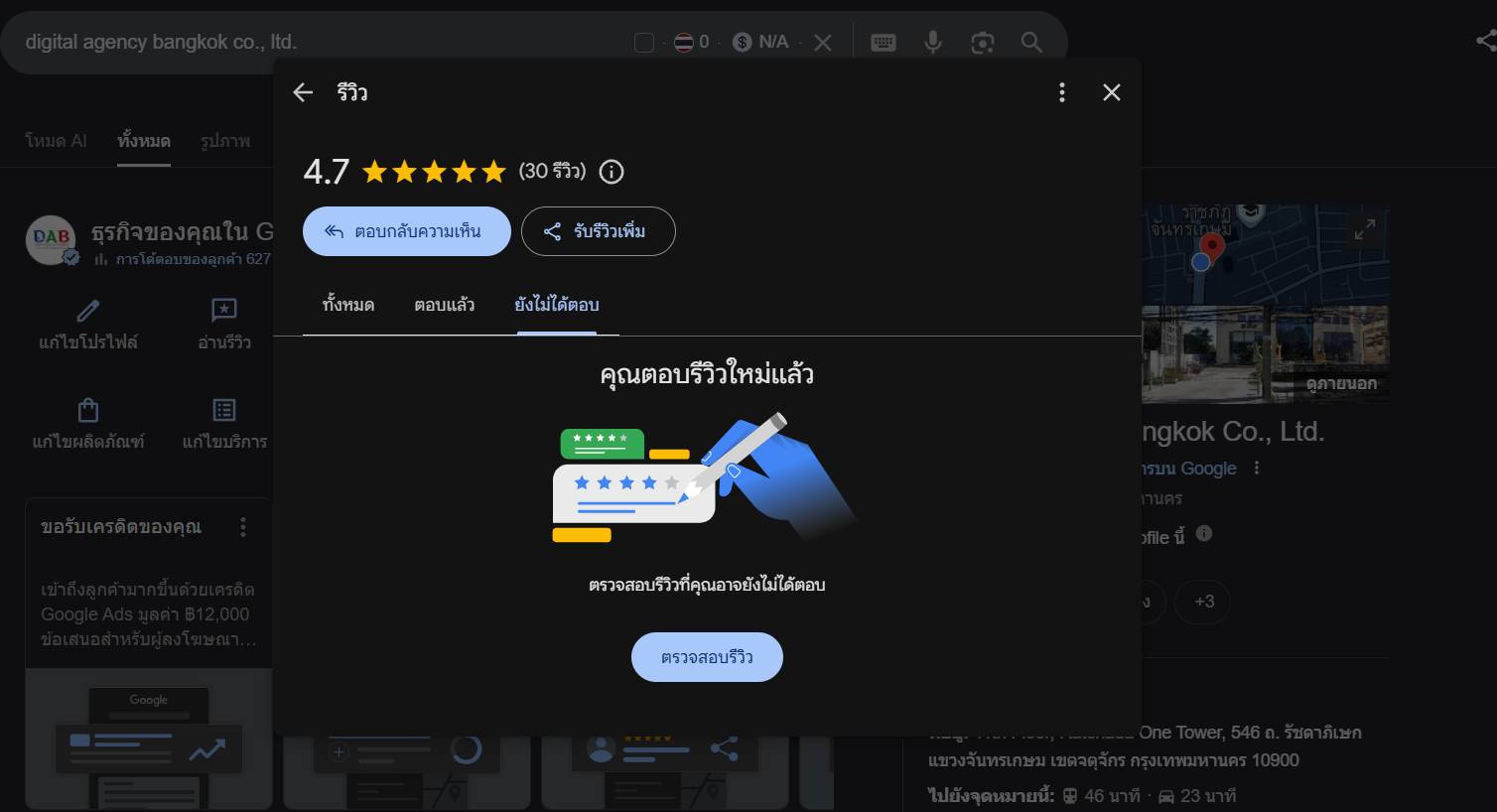
Reviews aren't just about trust with customers — they're a core ranking signal. What matters in 2026 isn't just the total number of reviews, but review velocity (steady new reviews over time) and how customers describe your services in their own words (keyword-rich reviews reinforce relevance). A business with 9 reviews and a business with 10 reviews can perform meaningfully differently in the map pack.
4. Thin or Generic Website Content
If your homepage says "We provide quality service to customers" without mentioning your city, neighborhood, or specific services, you're giving search engines nothing to match you against local queries. Google (and increasingly AI search tools) need explicit, specific, locally-anchored content to understand who you serve and where.
Example: A logistics company in Bangkok had a generic "About Us" page with no mention of the districts they served. After we added location-specific service pages ("Warehouse & Fulfillment Services in Bang Na," "Same-Day Delivery in Sukhumvit"), organic local traffic increased because the pages now matched how real customers were actually searching.
This matters even more once you consider how people actually phrase local searches. Almost nobody searches for "logistics company." They search "same day courier Sukhumvit" or "warehouse near Bang Na industrial estate." If your content never uses that language, you're asking search engines to make a leap they usually won't make on your behalf.
5. Inconsistent or Missing Citations Across Directories
Beyond your core NAP consistency, search engines also look at how many trusted third-party sources ("citations") confirm your business exists and is legitimate — think TripAdvisor, Yelp, Thai business directories, industry-specific listing sites, and Chamber of Commerce pages. A business with a handful of scattered, outdated, or duplicate listings sends a weaker trust signal than one with a clean, consistent footprint across the directories that matter for its industry.
Example: A boutique hotel in Ari had three different Google Maps listings created over the years by different staff members — one outdated, one duplicate, one current. Search engines couldn't confidently determine which one was authoritative, splitting the hotel's reviews and diluting its ranking signal. Consolidating into a single verified listing resolved the confusion and immediately improved map pack visibility.
6. Weak Local Backlink Profile
Links from other reputable local sites — Thai business directories, chambers of commerce, local news coverage, partner businesses — signal to Google that you're a genuine, embedded part of the local business community. Many businesses have zero local backlinks and rely entirely on generic, low-quality directory submissions that add little value.
7. No Mobile Optimization or Slow Load Times
Most local searches happen on mobile, often with high purchase intent ("near me," directions, click-to-call). A slow-loading or poorly formatted mobile site loses customers before they even see your offer — and search engines factor in these behavioral signals (click-through rate, bounce rate, time on site) when ranking local results.
8. Ignoring AI-Driven Local Search
Search is no longer just Google's blue links and the map pack. Tools like Google's AI Overviews, ChatGPT, and Perplexity are increasingly used to find local recommendations ("best Thai-English bilingual accountant in Bangkok," "reliable air-con repair near Silom"). If your content isn't structured clearly with direct, quotable answers, you're invisible to this growing segment of searchers — even if you rank fine in traditional results.
How Local SEO Fixes This: A Practical Roadmap
Step 1: Audit and Optimize Your Google Business Profile

- Choose the most accurate primary category, plus relevant secondary categories
- Fill out every attribute, service, and product field
- Add fresh photos and short posts weekly
- Ensure hours, phone, and address exactly match your website
- Respond to every review — positive and negative — since response activity itself is a behavioral signal
Step 2: Fix NAP Consistency Everywhere
Audit every listing — Google, Facebook, Line Official Account, industry directories — and standardize your business name, address, and phone number format across all of them. Keep a master document of exactly how your NAP should appear, down to abbreviations, so anyone updating a listing in the future stays consistent.
Step 3: Build a Review Generation System
Set up a simple, repeatable process (SMS, Line, or email follow-up after service) to request reviews consistently, rather than in occasional bursts. Steady velocity outperforms one-time review pushes. Where appropriate, gently prompt customers to mention the specific service they received — this naturally reinforces relevance for the search terms you care about.
Step 4: Create Location-Specific, Keyword-Rich Content
Build dedicated pages for each service and district you serve, using the language your actual customers use — not internal jargon. Include neighborhood names, landmarks, and practical local details. Where relevant, add a short section addressing common local questions directly, since this content doubles as AEO-friendly material.
Step 5: Earn Local Backlinks and Citations
Get listed accurately in trusted Thai and regional business directories, partner with complementary local businesses for cross-links, and pursue local press or industry association mentions. Prioritize quality over volume — a handful of relevant, authoritative local links outperforms dozens of low-quality directory submissions.
Step 6: Optimize for Mobile Speed and Usability
Compress images, minimize unnecessary scripts, and make click-to-call and directions buttons prominent and easy to tap. Test your site on an actual mobile connection, not just a desktop browser resized smaller — Bangkok's mobile network conditions vary significantly by area and time of day, and a page that loads instantly on office Wi-Fi can lag noticeably on a phone.
Step 7: Structure Content for AI and Answer Engines (AEO/GEO)
Write clear, direct answers to the actual questions your customers ask, use structured headings and FAQ sections, and add schema markup (LocalBusiness, FAQPage, Review) so AI tools and answer engines can accurately extract and cite your business.
How to Measure Whether It's Working
Local SEO isn't a "set it and forget it" project, and results should be trackable, not just assumed. A few metrics worth watching monthly:
- Map pack appearances: Are you showing up for your priority search terms when you search from a Bangkok IP address or check via Google's local search results?
- Google Business Profile insights: Calls, direction requests, and website clicks originating directly from your profile
- Review count and velocity: Total reviews, average rating, and how consistently new reviews are coming in month to month
- Organic local traffic: Visits to location-specific pages, tracked in Google Analytics or Search Console
- Keyword rankings for local terms: Position tracking for phrases that include your service plus district or "near me"
- AI citation visibility: Whether your business gets mentioned when you ask ChatGPT, Perplexity, or Google's AI Overview a relevant local question
Reviewing these numbers monthly (rather than only when business feels slow) makes it much easier to catch small issues — a duplicate listing, a lapsed review pace, a broken phone number — before they compound into a real ranking drop.
Common Local SEO Myths Worth Retiring
"My business has been around for years, so Google already trusts us." Longevity helps with credibility, but it doesn't substitute for active signals. A profile that hasn't been touched in two years reads as inactive, regardless of how long the business has actually operated.
"More reviews is always better, no matter how I get them." Review authenticity matters. A sudden spike of generic five-star reviews looks suspicious to both customers and to Google's spam detection systems. Steady, genuine reviews with specific details about the service received are far more valuable than volume alone.
"I don't need a website if my Google Business Profile looks good." GBP is powerful, but it's not a substitute for a website. Your site is where you control the message, capture leads directly, and provide in-depth local content that supports both traditional rankings and AI search citations.
"Local SEO is a one-time project." Rankings are relative — competitors are actively working on their own visibility, and search platforms update their algorithms regularly. Businesses that treat local SEO as ongoing maintenance consistently outperform those that treat it as a single fix-it project.
The Bottom Line
Not ranking locally is rarely about one single mistake — it's usually a combination of an unoptimized Google Business Profile, inconsistent business information, thin local content, and a weak review and backlink foundation. The good news: every one of these is fixable with a structured, ongoing local SEO strategy, not a one-time fix.
At Digital Agency Bangkok (DAB), we specialize in helping Bangkok businesses become visible exactly where their customers are already searching — Google Maps, local organic results, and now AI-powered search tools. If you're ready to find out exactly why your business isn't showing up, get in touch with our team for a local SEO audit.