


How AEO and GEO Are Transforming Search




How AEO and GEO Are Transforming Search
For roughly two decades, "search" meant essentially one thing: typing a query into a box, scanning a page of blue links, and clicking through to whichever result looked most promising. That model shaped an entire industry around it — traditional SEO, built around ranking as high as possible on that list of links, because ranking position was, for most of that era, the single most important variable determining whether a business got found at all.
That model hasn't disappeared, but it's no longer the whole picture, and for a growing share of searches, it isn't even the primary picture anymore. Increasingly, people ask a question and get an answer directly — a synthesized response generated by an AI system, sometimes with no need to click through to a website at all, sometimes citing a small handful of sources rather than presenting ten roughly equal blue links to sort through. This shift is what AEO (Answer Engine Optimization) and GEO (Generative Engine Optimization) exist to address, and understanding what's actually changed — and why it matters for any business relying on search visibility — has become one of the more urgent literacy gaps in digital marketing today.
What AEO and GEO Actually Mean
Defining the Terms Precisely
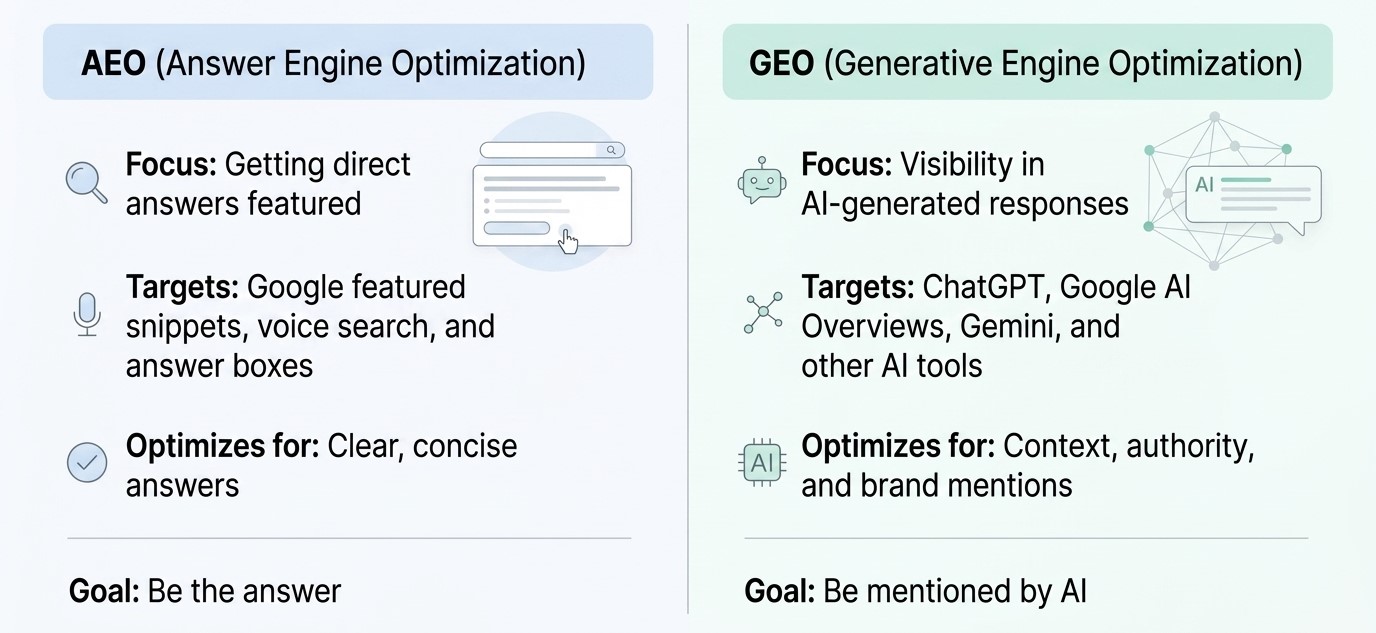
- AEO (Answer Engine Optimization) refers to optimizing content specifically to be selected as a direct answer by tools designed to answer questions concisely — voice assistants, featured snippets, and other formats that extract a single, focused response rather than presenting a full list of links.
- GEO (Generative Engine Optimization) refers to optimizing content specifically to be cited, referenced, or drawn upon by generative AI systems — tools like ChatGPT, Google's AI Overviews, Perplexity, and similar systems that synthesize an original, conversational answer by pulling from multiple sources, rather than simply returning a ranked list of links for a searcher to click through themselves.
The two overlap meaningfully and are often discussed together, but they aren't identical. AEO is about winning a single, extracted answer slot (a featured snippet, a voice assistant response). GEO is about being one of the sources an AI system draws from and potentially cites when generating a broader, synthesized response to a more complex or exploratory question.
Why This Shift Is Happening
Search Behavior Has Genuinely Changed
A meaningful and growing share of searches today are conversational, exploratory, and complex — the kind of query that doesn't map neatly onto a single webpage, but benefits from a synthesized answer pulling together information from several sources at once. Traditional search results, built around ranking individual pages, were never particularly well suited to that kind of query, and generative AI systems fill that gap far more naturally.
AI Systems Can Now Genuinely Understand and Synthesize Content
The underlying technology enabling this shift — large language models capable of understanding context, synthesizing information across multiple sources, and generating coherent, conversational responses — has matured to the point where doing this reliably, at scale, across huge numbers of queries, is now genuinely viable in a way it simply wasn't a decade ago.
Users Increasingly Prefer Getting Answers Directly
For many types of questions, particularly straightforward factual ones or requests for a quick synthesis of established information, users increasingly prefer receiving a direct, complete answer over having to click through, scan, and mentally synthesize information themselves across several separate pages — a preference reflected clearly in growing usage of AI-powered search tools and AI-generated overview features integrated directly into traditional search engines.
How This Actually Changes the Experience of Searching
From Ten Blue Links to a Single Synthesized Answer

Perhaps the most visible shift is structural: instead of scanning a list of roughly ten links and deciding which to click, a growing share of searches now surface a synthesized answer directly at the top of the results — or, in tools built entirely around this model, as the entire response itself, with no traditional link list involved at all.
From Many Roughly Equal Sources to a Small Number of Cited Ones
Traditional search results present multiple options with, in effect, roughly similar visibility across the first page. Generative answers typically draw from and cite a much smaller number of specific sources — meaning the difference between being one of the sources an AI system actually cites and being entirely excluded from that answer is a much starker, more binary outcome than the more gradual, position-based visibility of traditional rankings.
From Click-Driven Traffic to Answer-Driven Visibility Without a Click
A significant, and for many businesses concerning, shift is that a growing share of queries now get fully answered without the user ever clicking through to a source website at all — meaning traditional metrics like organic click-through traffic increasingly understate a business's actual visibility and influence within these newer search experiences, even when that business is being actively cited and relied upon by the AI system generating the answer.
Why This Matters for Businesses
The Visibility Stakes Have Changed Shape
In the traditional model, ranking on the first page — even at position eight or nine — still generated some visibility and traffic. In an AI-driven answer environment, being one of a small handful of sources actually cited or drawn upon carries far more weight, and simply existing somewhere in a search index without being selected as a citation source often results in close to zero visibility for that specific query, regardless of how technically well-optimized the page might otherwise be by traditional standards.
Trust and Authority Signals Matter Even More
Because generative systems are choosing which sources to trust and cite, rather than simply ranking pages by a mix of relevance signals, the underlying credibility, clarity, and authority of a source arguably matters even more than it did in traditional SEO — a page needs to not just rank reasonably well, but to appear genuinely trustworthy and clearly authoritative enough for an AI system to confidently draw from and attribute information to it.
Being Cited Can Drive Value Even Without a Click
Some businesses are beginning to recognize that being cited by name within an AI-generated answer — even without the user clicking through — still carries brand visibility and credibility value, similar in some ways to being mentioned favorably in a trusted publication, even if that specific mention doesn't drive direct website traffic the way a traditional search click would have.
The Competitive Landscape Is Being Reshuffled
Because AEO and GEO reward genuinely clear, well-structured, authoritative content rather than some of the more mechanical optimization tactics that worked reasonably well in earlier eras of traditional SEO, some businesses that ranked comfortably under the old model are finding themselves less visible in AI-driven answers, while other businesses with genuinely strong, clearly structured expertise — even if they weren't previously top-ranked competitors — are being surfaced and cited more prominently than before.
What Actually Improves AEO and GEO Performance
Content Structure That AI Systems Can Parse Clearly
- Clear, direct answers to specific questions, ideally stated plainly near the beginning of relevant content rather than buried beneath extensive preamble.
- Logical heading structures that make a page's organization and key points easy to extract programmatically, not just easy for a human to skim visually.
- Structured data (schema markup) that explicitly labels content types — FAQs, how-to steps, product details — giving AI systems clearer signals about exactly what a given piece of content represents.
- Concise, well-organized lists and tables where appropriate, since this kind of structured formatting tends to be easier for generative systems to extract and synthesize accurately than dense, unstructured prose.
Genuine Authority and Trustworthiness Signals
- Clear demonstration of real expertise — original research, direct experience, or credentialed authorship — rather than generic, thinly rewritten content that adds little beyond what's already widely available elsewhere.
- Strong off-page authority signals (backlinks, citations, brand mentions across credible sources), since these still matter significantly in establishing the kind of trustworthiness AI systems weigh when selecting sources to cite.
- Consistency and accuracy across a business's published content, since contradictory or unreliable information across a site undermines the kind of confidence an AI system needs to comfortably cite that source.
Directly Answering the Full Range of Questions an Audience Actually Asks
Since AEO and GEO reward content that directly and completely answers specific questions, businesses benefit from genuinely mapping out the real range of questions their audience asks — not just the handful of keywords with the highest known search volume — and building clear, direct content addressing each one specifically, since generative systems are often synthesizing answers to fairly specific, sometimes conversational or unusual phrasings of a question, not just the standard keyword variations traditional SEO historically focused heavily on.
A financial advisory firm, for instance, might find that traditional SEO efforts historically focused heavily on a handful of high-volume keywords like "retirement planning," while AI-driven search increasingly surfaces much more specific, conversational questions — "how much should I have saved for retirement by age 45" or "should I prioritize paying off my mortgage or investing more before retirement" — meaning the firm's content strategy needs to expand toward comprehensively answering that much wider, more specific range of real questions, rather than concentrating narrowly on a smaller set of high-volume traditional keyword targets.
How This Relates to, and Differs From, Traditional SEO
Overlapping Foundations
AEO and GEO aren't a wholesale replacement for traditional SEO practices — many of the same foundations still matter significantly: genuine content quality, technical site health, backlink authority, and clear site structure all continue to matter across both traditional search rankings and AI-driven answer selection. A business with strong traditional SEO fundamentals already has much of the foundation AEO and GEO build upon.
Where the Emphasis Shifts
- Traditional SEO historically placed significant weight on exact keyword matching and ranking position; AEO and GEO place more weight on directly and clearly answering the actual underlying question or intent, regardless of exact keyword phrasing.
- Traditional SEO success was measurable primarily through ranking position and click-through traffic; AEO and GEO success is increasingly measured through citation frequency and visibility within AI-generated answers, which requires different, often newer and less mature, tracking and measurement approaches.
- Traditional SEO rewarded being one of several roughly comparable results on a page; AEO and GEO reward being one of a much smaller number of sources an AI system actually chooses to rely on and cite.
Preparing a Business for This Shift
A Practical Starting Approach
- Audit existing content for how clearly and directly it answers specific, real questions an audience actually asks, rather than assuming keyword optimization alone is sufficient.
- Strengthen structured data implementation across key pages, giving AI systems clearer, more explicit signals about page content.
- Continue investing in genuine off-page authority building, since trust and credibility signals matter as much, if not more, in this newer environment.
- Monitor emerging tools and reporting that track citation and visibility within AI-driven answers specifically, since traditional analytics alone increasingly understate a business's actual search visibility.
- Treat this as an evolving, ongoing area rather than a one-time optimization project, since the underlying AI systems and their evaluation criteria continue to develop rapidly.