



How Much Should You Budget for Google Ads in 2026?





How Much Should You Budget for Google Ads in 2026?
Google Ads pricing in 2026 has no fixed cost because Google uses a real-time auction system. In Thailand, the average cost per click (CPC) typically ranges from THB 5–200 per click, depending on your industry, competition, and your ad's Quality Score. For most SMEs, a recommended starting budget is around THB 150–300 per day, allowing Google's AI enough data to learn and optimize campaign performance.
Why Doesn't Google Ads Have a Fixed Price?
Many business owners assume Google Ads has a standard pricing model similar to television commercials or billboard advertising. In reality, Google Ads operates through an Ad Auction that runs every time someone performs a search.
The auction is not determined simply by who bids the highest. Instead, Google considers two primary factors:
- Your maximum bid amount (Bid)
- Your Quality Score, which measures the relevance of your ads, expected click-through rate (CTR), and the user experience of your landing page.
As a result, businesses with highly relevant ads and optimized landing pages often pay less per click than competitors with larger budgets but lower-quality campaigns. This is why there is no single answer to the question, "How much does Google Ads cost?"
Common Google Ads Pricing Models
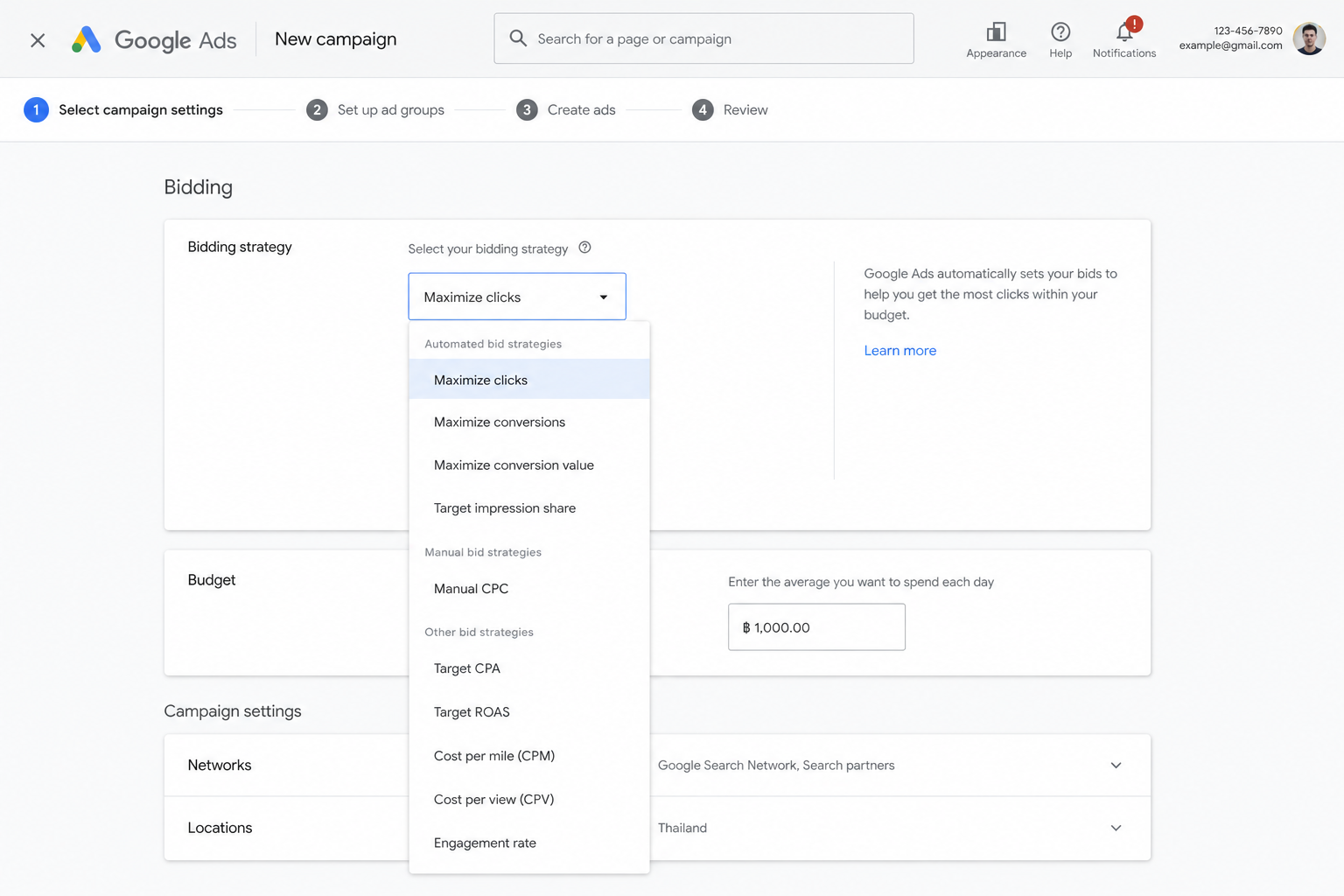
| Pricing Model | When You're Charged | Best For |
| CPC (Cost Per Click) | When someone clicks your ad | Search Ads, lead generation, and direct sales |
| CPM (Cost Per Mille) | Every 1,000 ad impressions | Brand awareness campaigns on the Display Network |
| CPV (Cost Per View) | When users watch your video according to Google's viewing criteria | YouTube advertising |
| CPA / Target CPA | Google's AI automatically adjusts bids to achieve your desired cost per conversion | Businesses with sufficient conversion history |
Choosing the right bidding strategy is just as important as setting the right budget. Even a large advertising budget may produce poor results if the bidding model doesn't align with your business objectives.
Average Cost Per Click by Industry (2026 Update)
The figures below represent estimated CPC ranges based on competition in the Thai market. Actual costs will vary depending on keywords, targeting, and competition.
| Industry | Estimated CPC | Competition Level |
| Finance & Insurance | THB 50–200+ | Very High |
| Beauty Clinics, Dental & Healthcare | THB 25–150 | Very High |
| Real Estate | THB 20–120 | High |
| Home & Local Services (Air Conditioning, Cleaning, Contractors) | THB 15–60 | Medium–High |
| B2B Software & Professional Services | THB 30–100 | Medium |
| Hotels & Travel | THB 10–40 | Medium |
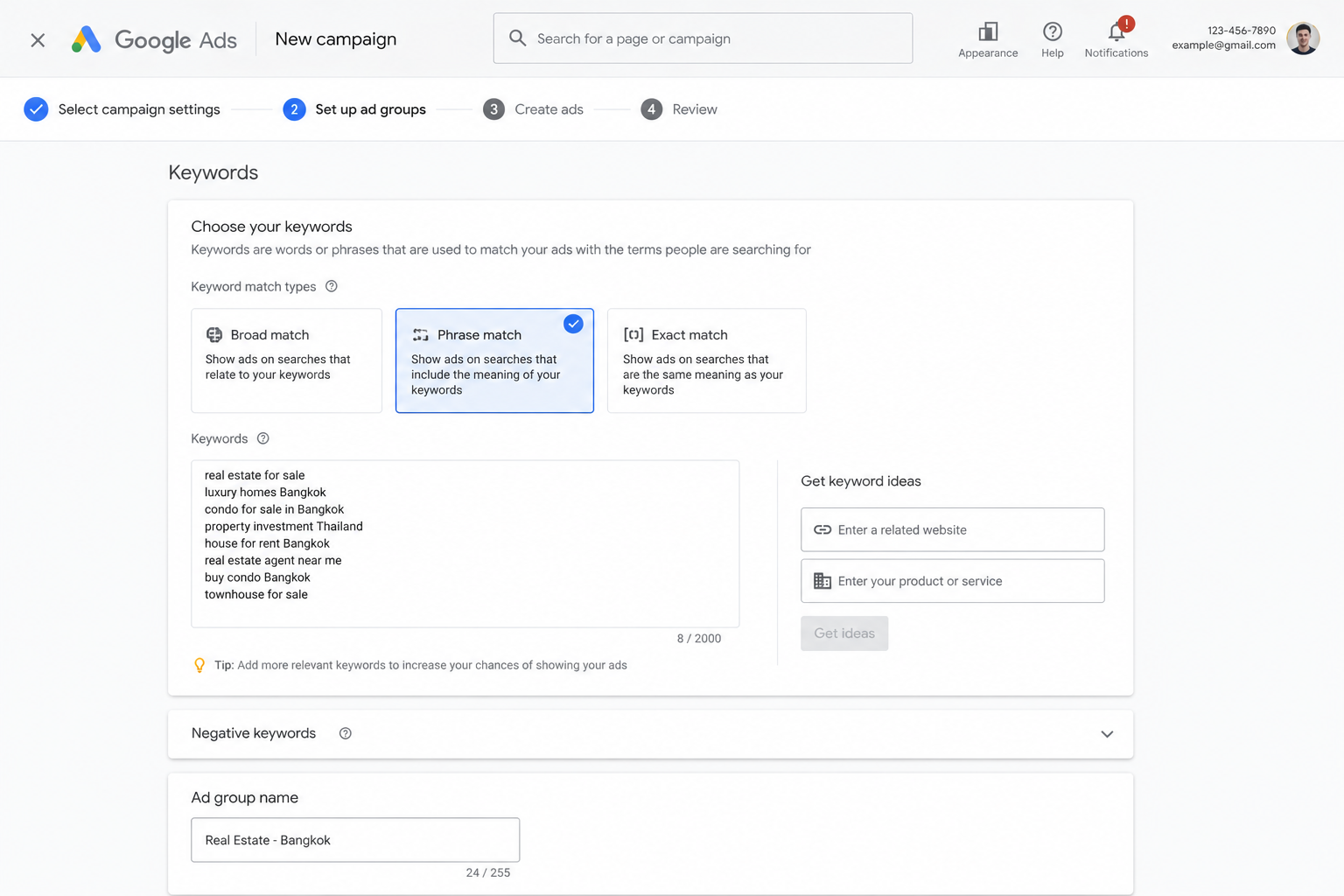
Important note: Industries with higher CPCs—such as real estate and healthcare—can still generate excellent ROI because each successful conversion has a significantly higher customer value. Meanwhile, local businesses such as restaurants often enjoy lower CPCs but face limited search volume within their service areas.
What Affects Google Ads Costs?
Several factors influence how much you'll pay for Google Ads:
Quality Score
A slow-loading website or landing page that doesn't match the user's search intent will generally increase your CPC.
Keyword Competition
Broad keywords are usually much more competitive than long-tail keywords, making them more expensive.
Target Location
Advertising nationwide typically costs more than focusing on specific cities or service areas.
Seasonality
Industries such as tourism, retail, and gift businesses often experience higher advertising costs during peak seasons and holidays.
Device & Ad Placement
Costs may vary depending on whether users search from mobile devices, desktops, or tablets.
How to Reduce Google Ads Costs Without Sacrificing Performance
You don't always need a larger budget to improve results. Consider these optimization strategies:
- Improve your landing page speed and relevance to increase Quality Score.
- Use Negative Keywords to exclude irrelevant searches (for example, premium brands may exclude terms like "free" or "cheap").
- Narrow your geographic targeting to the areas you actually serve.
- Run A/B tests on multiple ad variations to identify the highest-performing copy.
- Set up accurate Conversion Tracking so Google's automated bidding can optimize more effectively.
Recommended Budgets by Business Size
| Business Size | Recommended Daily Budget | Best For |
| Startups & Market Testing | THB 150–300/day | Collecting data and testing keywords |
| Established SMEs | THB 500–1,500/day | Generating consistent leads and sales |
| Highly Competitive Industries (Real Estate, Healthcare, Finance) | THB 1,500+/day | Competing for top positions on valuable keywords |
These figures should be treated as starting points rather than fixed rules. Most campaigns require ongoing optimization during the first 2–4 weeks before determining the ideal budget.
Conclusion
The cost of Google Ads in 2026 depends on multiple factors, including your industry, competition, targeting strategy, and campaign quality. While understanding average CPC benchmarks provides a useful starting point, maximizing your return on investment requires continuous optimization, strategic bidding, and data-driven decision-making.
Ultimately, successful Google Ads campaigns aren't defined by how much you spend—they're measured by how effectively your advertising budget generates qualified leads and profitable sales.