


Why Real Estate Websites Fail in Thailand




A real estate website in Thailand fails in ways a person can check without a report. The page does not match what staff will say. The same name sits on two URLs. A form arrives with nobody named on it. A phone cannot finish the next step. This note diagnoses four patterns: a theme that assumed a portal, duplicate listings, no lead routing or CRM, and a slow mobile path. It is not a rant, and it is not a service page. How this vertical is scoped sits on our real estate web design page. This article sets no fee, no failure rate, no traffic figure, and no lead count.
Short answer: Name the business, then turn off what the theme assumed. A developer site needs one URL per public project name and a project inquiry a named person will see. An agent site needs a listing or an area, then an agent lead that names who replies. The sibling on real estate website structure, project versus agent is the tree. The sibling on Google Ads for Thai real estate is channel choice. This page is the diagnosis. It changes no live path.
What “fail” means here
Do not start with a rank or a session count. The site fails when someone who already knows the project cannot finish the request the office will still honour.
Check four things, in order. What the theme assumed about inventory. Whether each public name has one URL the office will send. Whether a named person sees the request with that name still attached. Whether a phone can complete that step. A new theme, a CRM logo, or an ad account does not answer those checks.
Theme and template sites
A property theme often ships a portal: market search, price and district filters, an agent grid, a payment widget, and a button that says book, register, or submit a listing. Using a theme is not the failure. Leaving that model on, when the office will not run it this month, is the failure.
A developer site fails when the first click is a search the gallery will not maintain. Staff should send one URL with the public name. A price filter the desk will not quote, and agent cards for people who do not reply, are promises the template made. An agent site fails when a one-launch brochure hides the listing and the person who replies.
What to switch off before a rebuild
Open the homepage and one URL a sales person would send. Note leftover demo copy, a search of sold phases or other developers’ stock, a mobile nobody answers, and a map of projects the company will not discuss. Switch those off or relabel them before a rebuild.
Keep the public name readable and one next step: a project inquiry, or an agent lead. If the only working button leaves the domain for a portal, write that internally. Do not call the company page a lead path unless the request still reaches someone the company named.
Duplicate listings
A duplicate is more than one public URL for one name the office will send, or the same claim pasted onto every project because a template field was empty. It is also a portal row copied onto the company site and left up after that row changed. The visitor does not know which URL is true. Staff do not know which form belongs to which record.
Do not invent a count of duplicates. List the public names, or the listing identifiers, the office will still honour. Search the company’s own domain for each name. If one public name has two URLs, and a phase does not have its own public name, one URL is extra. Compare the status words with what the desk will say this week.
What is not a duplicate
A Thai page and an English page are a language pair if staff will honour both. An index plus the project page is a tree, not a second listing. Two pages for the same identifier, each with its own form, is a duplicate until the office names who replies.
The extra URL usually arrives because the theme made a property for every photo set, or a portal row was copied and then paused. A claim true of one project only must not move onto the next. One public name, one URL the company will send. This page does not change a live slug and does not invent a redirect.
No lead routing, and no CRM the desk uses
A form that emails a shared inbox, with the project name stripped off, is not lead routing. A CRM logo is not routing. A chat button nobody checks after they leave is not routing. Routing means the request keeps its identifier and a named person sees it. If both products exist, label a project inquiry and an agent lead. The structure note draws those trees.

Write who sees each path. Open the form on a phone. Submit a test. Confirm the named person saw the identifier, the question, and the language. Do not count the test. Do not publish a lead count or a reply time.
What the broken path looks like
The thank-you line is the same for a visit, an agent question, and an owner who wants to list. The message has no project name. LINE, a published mobile, and the form are three inboxes, and nobody wrote which one is the record. A CRM exists, and the person who replies does not open it. A budget field is noise if the desk will not quote.
Fix the label before you add software. A project inquiry carries the project name. An agent lead names the listing and who will see it. A generic contact page must not be labeled as both. A CRM helps only if that person already works there and the row still has the identifier.
Slow mobile, as a path, not a score
This page does not measure a speed score, and it does not invent a millisecond figure. Slow means a person on a phone cannot finish the labeled request. Open the URL a sales person would text. The name is readable. The next step is a project inquiry or an agent lead, not a search of the whole market.
Watch what pushes that step away. A locked hero taller than the name. A chat that covers the button. A language switch that drops the project name. If the only button that still works leaves the domain, write that down.
A phone pass for this week
Send yourself the URL you would send a visitor. Read the name and the status. Find one labeled next step. Do not submit a test you will count. Note what blocked the button, and hand that note to whoever edits the theme. A faster theme on a wrong URL is still the wrong URL.
A diagnosis order, not a score
Do the first items if the week is short. Do not fill a slide with a volume, a rate, or a price this article refused to invent.
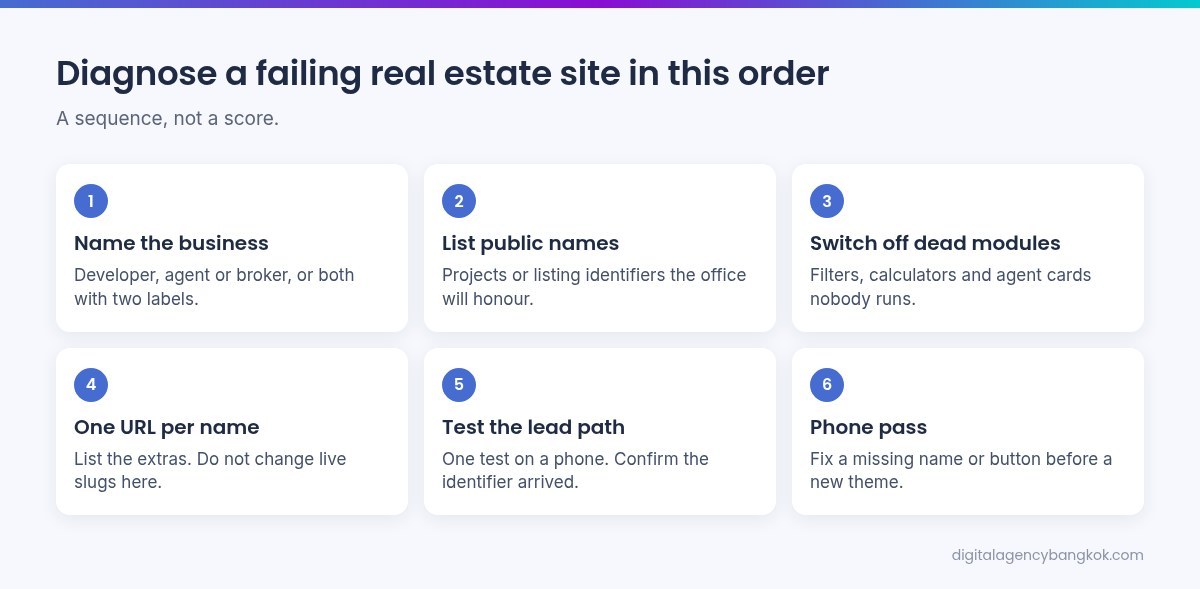
- Name the business: developer, agent or broker, or both. If both, keep two labels.
- List the public names, or listing identifiers, the office will still honour.
- Switch off modules nobody will run: market search, a price filter, agent cards that do not reply, a calculator, owner listing without a path.
- Give each public name one URL the company will send. List extras. Do not change a live slug from this page.
- Label the lead path. Send one test on a phone. Confirm the identifier arrived. Do not count the test.
- Repeat the phone pass on the URL you would text. Fix a missing name or button before a new theme or a CRM product.
What to hand a website team
Hand a source of truth, not a request for more leads. The public names. Which modules to switch off. The listing identifier the office already uses. Who sees a project inquiry, and who sees an agent lead. Status words staff already use, the URL you would text, and the note from the phone pass.
The team may align the URLs you listed and wire the form so the named person sees the identifier. They may not invent a project, merge two lead types, or treat a test as demand.
Before the next theme or the next tool
The four failures stack. A portal theme creates pages the office will not maintain, and those pages become duplicates. The form drops the name. The phone cannot reach the labeled step. Channel choice does not repair that.
Do the checks, then talk about a rebuild. A scoped conversation belongs on real estate web design. The tree is on real estate website structure, project versus agent. Channel choice is on Google Ads for Thai real estate. This page quotes no price, reports no failure rate, no traffic, and no lead count. It does not link a Google Ads service page or a hotel service page. It changes no live path.
FAQ
Does a property theme mean the website has failed?
No. A theme fails when its portal assumptions stay on and the office will not run them. Switch off a market search, a price filter, or agent cards that do not reply before you buy another theme. Keep one URL per public name, and one next step a named person will see.
What counts as a duplicate listing?
More than one company URL for one public name the office will send, unless a phase has its own public name. A Thai and English pair is not a duplicate if staff honour both. Do not invent a count.
Do we need a CRM before lead routing works?
No. Routing means the request keeps the project name or listing identifier, and a named person sees it. Send a test on a phone and do not count it. A CRM helps only if that person already works there and the row still has the identifier.
How do we tell that mobile is the problem without a speed score?
Open the URL you would text. The name is readable. The status matches what staff will say. One labeled next step is reachable. This page sets no millisecond figure and no rank. A faster theme on the wrong URL is still the wrong URL.
Where is the price, and how is this different from the sibling notes?
Not here. This page sets no fee, failure rate, traffic figure, or lead count. The structure note draws the project tree and the agent tree. The ads note is channel choice. A scoped quote belongs on the real estate web design page.