


Hotel Website SEO vs OTA Dependence: A Decision Guide for Thai Hotels





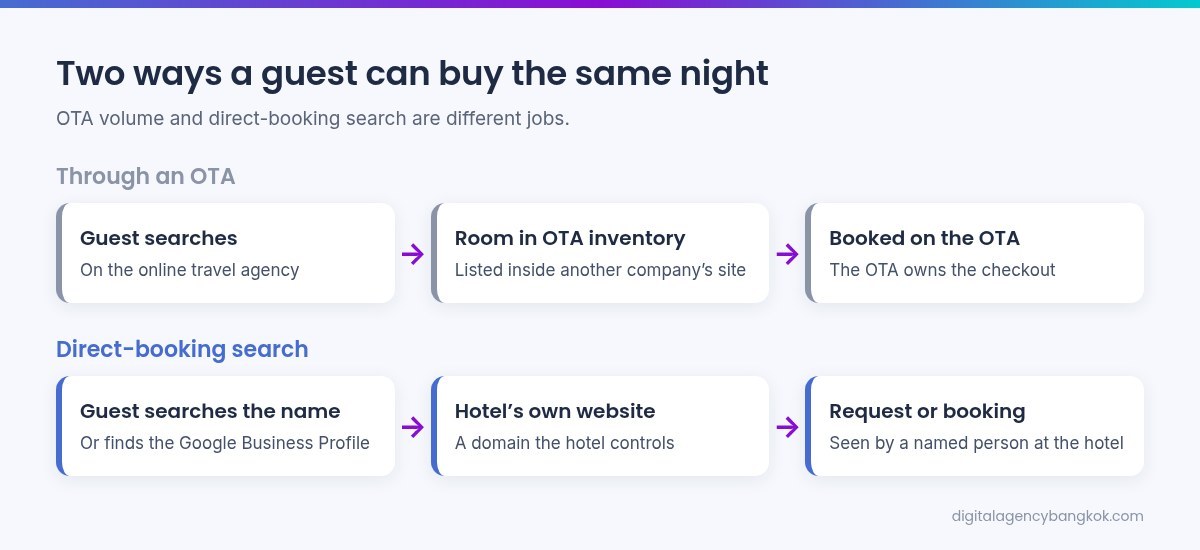
A hotel in Thailand can sell the same night in two places. One is an online travel agency, where the room sits in another company’s inventory. The other is the hotel’s own website, where a search for the name, a room still on sale, or a place plus a stay can land on a page the hotel controls. Hotel website SEO is that owned path. Buying more Agoda or Booking traffic is a separate purchase. How the site is scoped sits on our hotel web design agency page. This article sets no fee, no commission, no occupancy figure, and no rank.
Short answer: Invest in the site, the Google Business Profile website field, and direct-booking search when a guest cannot finish the next step on a page the hotel owns. Use the existing hotel website checklist for the pages that path needs. The pin, hours, and reviews are the sibling note on local SEO for hotels. Buy more OTA volume only when those nights are already placed in that marketplace and the owned path is not ready.
Buying more OTA traffic is not hotel website SEO
An OTA is a marketplace. The hotel lists rooms there. This page does not quote a commission, a bid, or a share of the stay. More presence there can fill rooms the hotel chose to sell that way. It does not create a page on the hotel’s domain.
Hotel website SEO is the owned path. A person types the public name, a room type you still sell, or a district or beach plus a stay, and can reach a page that says what is true this week. The hotel does not control the search layout, and this article will not invent a position.
Turning up an OTA campaign because the site feels slow is a cash decision. It is not a measurement that search on the hotel’s pages failed. This page claims no booking count and no result in which one channel beats the other. A vendor’s rule of thumb is not a DAB measured result.
What direct-booking search actually is
Direct-booking search is demand that can land on the hotel’s own domain. It includes people who already know the name, people who search a room you still sell, and people who search a place plus a stay and need a page that names the property honestly. It is not a promise that the hotel will outrank a marketplace.
The page should say what the desk can say. The entrance guests use. The room types still on sale. What is closed this season. How a person asks for a night, or completes a stay, on the hotel’s system if the hotel sells that way. If the only button sends the guest to an OTA, write that in the internal note. Do not label it “book direct” unless staff can explain the hop.
The test is whether a named person can show, on the live domain, how last week’s direct enquiry arrived and who replied. If not, the hotel does not yet have a path to invest search into. Fix that path before you buy more marketplace traffic to hide the gap.
The page the hotel name should open
When someone searches the hotel’s public name, know which URL you want them to meet. Often that should be the hotel’s own homepage or a stay page, not only an OTA listing the hotel cannot edit after a contract change. If the name on the sign and the name on the site disagree, fix the name first.
When a Thai hotel should invest in its own site first
Use the site first when any of these are true this month. The hotel cannot show the stay, the place, or how to arrive on its own URL. The Google Business Profile website field opens an OTA, or a page that still sells last season’s rooms. Staff quote hours, or a closed wing, that the website still contradicts. Guests already search the name, or a previous vendor still holds the domain.
None of those sentences is an occupancy target. They are ownership tests. If one is true, the next spend is pages and a path, not another increment of marketplace traffic. The checklist already lists what a booking-minded hotel site should include. This article does not rewrite that post and does not change its slug.
What ready means before search
Ready does not mean a new theme. Open the live site on a phone. The public name matches the sign. The rooms on the page are rooms you will still honour. The way to ask or book works, and a named person sees the request. The website field opens that same domain.
Where the Google Business Profile fits
The profile is the public listing a guest meets on a map and in local results. This article does not walk the pin, the hours, or the review habit. Those sit on the local SEO for hotels note. When the owned site is the door you want, the website field should open that domain, not only an OTA link.
An agency may be a manager. The hotel should be able to remove that access. Do not rename the hotel into a keyword, and do not buy reviews. Change the website field on the day the domain is the one a guest should open.
When more OTA traffic is still a cash choice
Some weeks the hotel should buy more marketplace presence. The hotel has nights it has already chosen to sell inside that contract. The owned site cannot yet take a request a person will answer, and a peak is closer than the site work.
Write the reason in one sentence the owner can repeat. We sell this block there until the site can take the same request. Or we sell this block there because the contract already covers it, and the site is a separate job. Do not treat an invoice as proof that search does not work for hotels.
A decision guide the owner can run this month
This is a sequence, not a score. If the week is short, do the first four and write the answer down. Do not fill a slide with a rank or a rate this article refused to invent.
- Name the domain the hotel owns, and who can change the content if a vendor leaves. Recover the login first if that person is missing.
- Open the live homepage on a phone. Confirm the name, a room you still sell, and a way to ask or book that a named person will see.
- Open the Google Business Profile. Confirm the website field opens that domain. Leave the pin, hours, and reviews to the local SEO note.
- Search the public name in a private window. Note which URL you wish guests to meet. Do not record a position. The note is whether that URL exists and is one you control.
- Read the OTA invoices as invoices. Ask finance what the hotel chose to sell there. Do not replace that reading with a commission figure from a blog.
- If the site cannot take the same request, use the hotel website checklist before you buy more volume to hide the gap.
- If the path works, decide which demand should land on it: the name, the rooms you still sell, and the place page a guest needs. That is direct-booking search.
- Write one sentence for the month: the owned path, more OTA volume because the path is not ready, or both. Do not report a vanity win.
What to hand a hotel website team
Hand a source of truth, not a blank brief. The name on the sign. The room types still on sale. What is closed. The phone a person answers, matching the website. The domain login, and who sees a form at night. The OTA names the hotel uses, as contracts, not as rates this article will quote.
The team may design and build on the hotel’s domain. They may not stuff the title with districts, invent a star claim, or publish a price the desk will not honour.
What to do before the next OTA increment
Recover the domain if the hotel cannot edit it. Point the Google Business Profile website field at that domain when the site is the door you want. Fill the gaps the checklist names. Keep Maps work on the local SEO note.
A scoped website conversation belongs on hotel web design. This page quotes no price, reports no client booking number, and changes no live path. It does not link a local SEO service page or a separate hotel ads page.
FAQ
Is hotel website SEO the same job as buying more OTA traffic?
No. Hotel website SEO is the owned path: pages on the hotel’s domain that match the desk and can take a request or a stay. An OTA is a marketplace listing under that company’s terms. You can run both. More OTA presence does not create a page you still own if the listing pauses. This page quotes no commission.
When should a Thai hotel invest in its own site before more OTA volume?
When a guest who knows the name, or who needs the stay and the place, cannot finish the next step on a page the hotel owns. That includes a website field that opens only an OTA, a site that still sells a closed wing, or a domain a previous vendor still holds.
What is direct-booking search, without a promised rank?
It is demand that can land on the hotel’s own domain: the public name, a room you still sell, and a place page a guest needs before a direct booking. It is not a promise of position and not a bid this article sets. The test is whether the preferred URL exists, matches the desk, and has a next step a named person will see.
What should the Google Business Profile do in this decision?
When the owned site is the door you want, the website field should open that domain, not only an OTA link. Recover access if nobody at the hotel can edit the profile. Do not buy reviews or rename the hotel into a keyword. The pin, hours, and review habit sit on the local SEO note, not here.
Where is the price, and how is this different from the checklist and the Maps note?
Not here. We do not set a fee, a rank, a commission, or a booking number. The checklist covers pages a guest needs before a direct booking. The local SEO note covers Maps, the pin, and reviews. This page is the decision between the owned path and more OTA volume. A scoped quote belongs on the hotel web design page.