


How to Choose the Right SEO Company for Your SaaS Business

How to Choose the Right SEO Company for Your SaaS Business
Choosing an SEO agency feels overwhelming when every pitch sounds the same: "We'll boost your rankings." "We'll drive more traffic." But traffic isn't the goal — pipeline is. If you run a SaaS company, the wrong hire can burn months of budget on tactics built for e-commerce or local businesses, not for a B2B buyer journey with a long, research-heavy sales cycle.
Below is a practical framework for evaluating SEO agencies, built specifically around what matters for SaaS: qualified leads, not just clicks.
Getting this decision wrong isn't just a wasted budget line — it's months of opportunity cost while competitors capture the search visibility you should have owned. This guide walks through why SaaS SEO requires a different playbook, the exact criteria to evaluate an agency against, red flags to watch for, and what a realistic timeline for results actually looks like
Why SaaS SEO Is Different From E-Commerce SEO
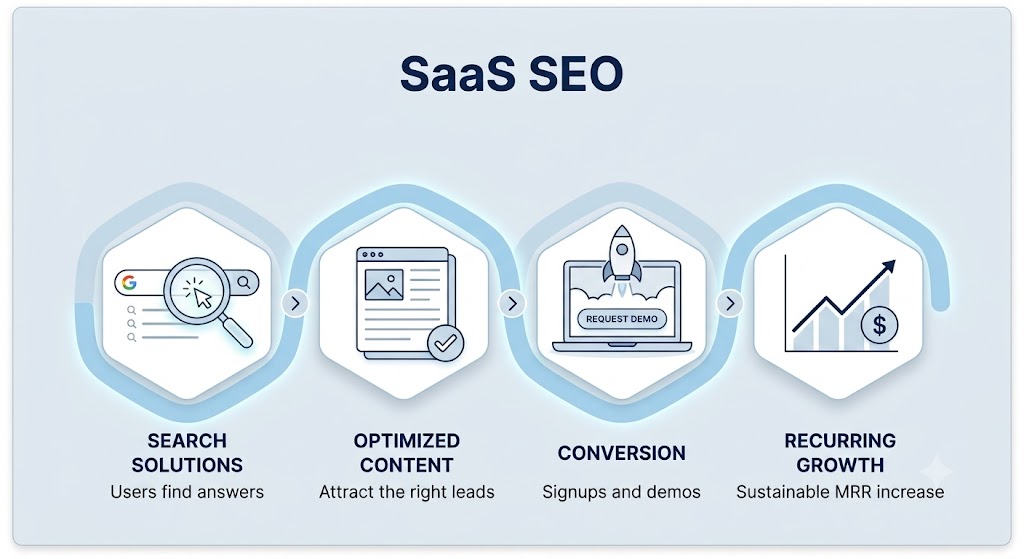
SaaS buyers don't behave like online shoppers. They research for weeks or months, compare alternatives, read documentation, and often need buy-in from multiple stakeholders before signing up for a demo. That means SaaS SEO depends on:
- Long-tail, problem-aware keywords rather than high-volume product terms
- Content mapped to the funnel — top-of-funnel education, middle-funnel comparison content, bottom-funnel conversion pages
- Technical SEO for product-led growth, including help docs, integration pages, and app-adjacent content
- Conversion paths built around demos, trials, and MQLs, not "add to cart"
An agency that built its playbook on e-commerce clients may optimize for the wrong outcomes entirely. They might celebrate a spike in blog traffic from a broad, top-of-funnel keyword while ignoring that none of that traffic ever reaches a pricing page, a demo request form, or a trial signup. In SaaS, visibility without qualification is just noise.
This is also why SaaS SEO tends to move on a longer timeline than e-commerce SEO. A retail site can sometimes see a sales lift within weeks of a promotional push. SaaS content, by contrast, often needs to earn trust across multiple touchpoints — a blog post, a comparison page, a case study, a free-trial landing page — before a lead converts. An agency that doesn't set this expectation up front, or that promises fast wins without qualifying what "wins" means, is either inexperienced with SaaS or not being fully transparent
The 5-Point Framework for Evaluating an SEO Agency
1. Industry Experience With SaaS and B2B
Ask directly: "Have you worked with SaaS companies before, and how would you approach our funnel?"
A good agency should be able to speak fluently about B2B buyer journeys, multi-touch attribution, and how organic content supports sales — not just how it ranks. If the answer is vague or generic, that's a signal.
2. Tailored Strategy Over Cookie-Cutter Proposals
Be cautious of any agency that hands you a proposal before doing real research on your business, competitors, or niche. A tailored strategy should reference:
- Your actual competitors and where you're losing visibility to them
- Gaps in your current content relative to buyer intent
- Specific problems your SEO program needs to solve — not a generic task list (backlinks, blog posts, meta tags)
If the pitch could be copy-pasted for any company in any industry, it probably was.
3. Communication and Transparency
This is where many SEO relationships break down. You want an agency that:
- Provides regular updates with actionable data, not vanity metrics
- Clearly explains what they prioritize (rankings, organic traffic, MQLs, demo requests) and why
- Is willing to show you the reasoning behind their strategy, not just the output
Ask upfront: "How do you report results, and what metrics do you prioritize?" Their answer tells you a lot about whether they're optimizing for your business outcomes or their own retention.
4. Cost vs. ROI
SEO is an investment, and price should track value delivered — not the reverse. For SaaS specifically, judge ROI by:
- MQLs (marketing qualified leads) generated from organic traffic
- Demo requests or trial signups attributed to organic content
- Pipeline influence, not just keyword rankings
It's usually better to pay more for an agency that understands how to convert organic traffic into revenue than to save money on one that inflates traffic numbers without moving the business forward. Agencies that specialize in B2B and SaaS — such as Growth Partners Media, which focuses specifically on this space — tend to have a better read on these nuances than generalist agencies, since their entire model is built around SaaS buying behavior rather than adapted from broader retail or local SEO work. Worth a look if you want a partner who already speaks the language of MQLs and pipeline, not just impressions.
5. Proof That Matches Your Business Model
A strong agency should be able to show current, relevant proof — not just a logo wall. Ask for:
- Websites or clients they've optimized that resemble your business model
- The specific problems they were hired to solve
- What work they actually did (technical fixes, content strategy, link building, etc.)
- The measurable results that followed
If a case study is from a completely different industry or business model, treat it as a weak signal rather than strong evidence.
It also helps to ask how the results were achieved, not just what the results were. A jump in traffic from a viral, unrelated blog post is a very different achievement than a steady climb in rankings for commercial-intent, product-relevant keywords that consistently feed the sales pipeline. The second is far harder to manufacture — and far more valuable to your business
Red Flags to Watch For
Even strong-sounding pitches can hide weak fundamentals. Some warning signs worth taking seriously:
- Guaranteed rankings or timelines. No agency can guarantee a #1 Google ranking by a specific date — search algorithms don't work that way, and anyone promising this is either inexperienced or overselling.
- Vanity-metric-only reporting. If every report leads with traffic or keyword count and never mentions leads, conversions, or pipeline, you're not getting the full picture.
- Heavy reliance on link-buying or automated outreach at scale. Aggressive, low-quality link building can create short-term ranking gains and long-term risk, including potential penalties.
- No clear point of contact or strategist. If you can never get a straight answer from a real strategist — only account managers relaying information — communication will likely suffer over time.
- One-size-fits-all packages. SEO "tiers" sold identically to every client, regardless of industry, are a sign the agency isn't customizing strategy to your business.
- Reluctance to share past client results. Agencies confident in their work are usually willing to share relevant examples, within the bounds of client confidentiality.
None of these are automatic disqualifiers on their own, but two or more together are worth a serious conversation before signing anything.
What a Realistic SEO Timeline Looks Like for SaaS
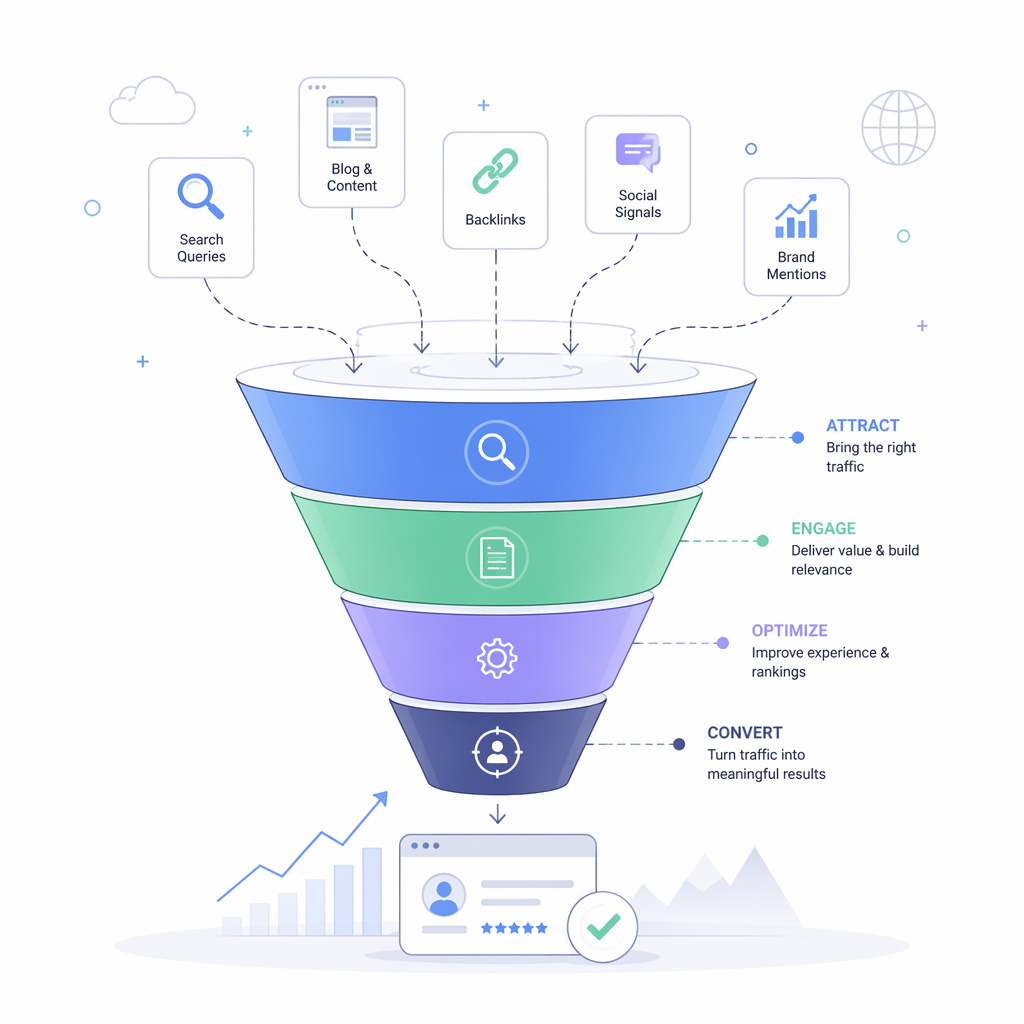
SaaS SEO is a compounding investment, not a quick campaign. While every business is different, a rough timeline often looks like:
- Months 1–3: Technical audit, keyword and competitor research, content strategy build-out, and early publishing. Expect foundational work more than visible results.
- Months 3–6: Initial ranking movement for lower-competition, long-tail terms; early signs of organic traffic growth.
- Months 6–12: Meaningful growth in organic traffic and, ideally, MQLs or demo requests as content matures and authority builds.
- 12+ months: Compounding returns, where a growing library of ranking content continues to drive pipeline with a lower incremental cost per lead.
Any agency promising dramatically faster results across the board should be asked to explain exactly how — and whether that approach carries long-term risk
What Makes a Good SEO Company?
Choosing an SEO agency for a SaaS business should involve more than comparing prices or projected traffic. The right partner should be able to drive measurable business outcomes that align with your growth objectives. A strong SaaS SEO agency should offer the following:
- Relevant industry experience, particularly with SaaS or B2B businesses.
- A funnel-driven SEO strategy tailored to your customer journey rather than a one-size-fits-all approach.
- Transparent reporting tied to business metrics such as MQLs, demo requests, free trial signups, and pipeline growth.
- An ROI-focused approach, prioritizing revenue impact over raw organic traffic.
- Proven case studies and measurable results from businesses with a similar business model.
If an agency is missing more than one of these core qualities, it may be a sign that they're not the right long-term partner for your SaaS growth, and it's worth exploring other options
Bottom Line
Choosing an SEO company for a SaaS business comes down to fit, transparency, and proof — not just price or promises. Use this framework during consultations, ask pointed questions, and require evidence that matches your business model before signing a contract.