



Why Real Estate Businesses Need More Than a Standard Website





Why Real Estate Businesses Need More Than a Standard Website
A developer once described his agency's old website this way: "It looked great in the pitch meeting and fell apart the moment we actually tried to use it." He wasn't talking about a design flaw in the traditional sense — the colors were on-brand, the photography was sharp, the homepage was clean. What he meant was that the site had been built the way most business websites are built, and a property business isn't most businesses. It needed to do things a standard website was never designed to do: filter hundreds of listings by six variables at once, sync automatically with an MLS feed, let buyers save searches and get notified when something new matched, and hold up under the load of thousands of visitors browsing simultaneously during a launch weekend. None of that happened. He rebuilt from scratch, this time with a team that understood the difference.
That story captures something a lot of real estate businesses learn the expensive way: real estate web design isn't a stylistic variation on regular web design. It's a different category of problem, with different technical requirements, different data structures, and a different bar for what "finished" actually means. Understanding that distinction before committing a budget to a build is one of the more consequential decisions a property business will make.
Two Websites, Two Very Different Jobs
Picture two projects landing on a developer's desk in the same week.
The first is for a boutique law firm — a handful of service pages, an about page introducing the partners, a blog for legal insights, a contact form. Everything on the site is static or close to it. Content changes occasionally, but nothing on the site needs to respond dynamically to what a specific visitor is looking for. This is regular web design, and it's the kind of project a well-built WordPress or Webflow site handles comfortably.
The second is for a real estate brokerage with 400 active listings, a sales team who need to update pricing and availability constantly, and buyers who expect to filter by bedroom count, price range, square footage, neighborhood, and property type simultaneously — then save that exact search and get an email the moment something new fits it. This is a fundamentally different kind of build. It needs a searchable, filterable database behind the scenes, not a collection of static pages. It needs to pull live data from an MLS or IDX feed and keep that data synchronized automatically. It needs to perform well even when hundreds of people are running searches at once. None of that is "web design" in the traditional sense — it's closer to application development wearing a web design's clothing.
That's the heart of the distinction: regular web design is built to present information. Real estate web design has to organize, filter, and serve a constantly changing dataset — and do it fast, accurately, and at scale.
Where the Two Actually Diverge
The Data Problem
A regular business website typically has a manageable, mostly static amount of content — a dozen pages, maybe a blog that grows over time. A real estate website is, structurally, a live database wearing a website's interface. Listings are added, updated, and removed constantly. Prices change. Properties go under contract and need to reflect that instantly, since nothing damages trust faster than a buyer inquiring about a property that sold two weeks ago.
Handling that well requires a proper database architecture, not a stack of manually edited pages — and increasingly, it requires integration with an MLS (Multiple Listing Service) or IDX (Internet Data Exchange) feed, so listings sync automatically rather than requiring someone to manually re-enter every new property by hand.
Search and Filtering
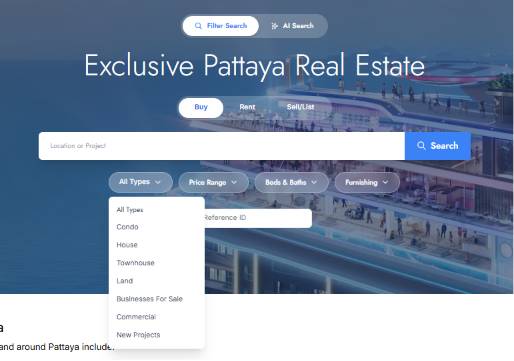
Regular websites usually need, at most, a simple keyword search box. Real estate sites need multi-parameter filtering — price range sliders, bedroom and bathroom counts, square footage, lot size, property type, neighborhood boundaries, sometimes even school district or commute-time filters — all of which need to work together instantly, without the page reloading awkwardly or the results lagging behind what the user just selected.
Building that well is a genuine engineering task. It means structuring a database so those queries run efficiently even as the number of listings grows into the hundreds or thousands, and building a front-end interface that feels instant rather than sluggish, even while filtering a large dataset in real time.
Maps as Core Functionality, Not Decoration
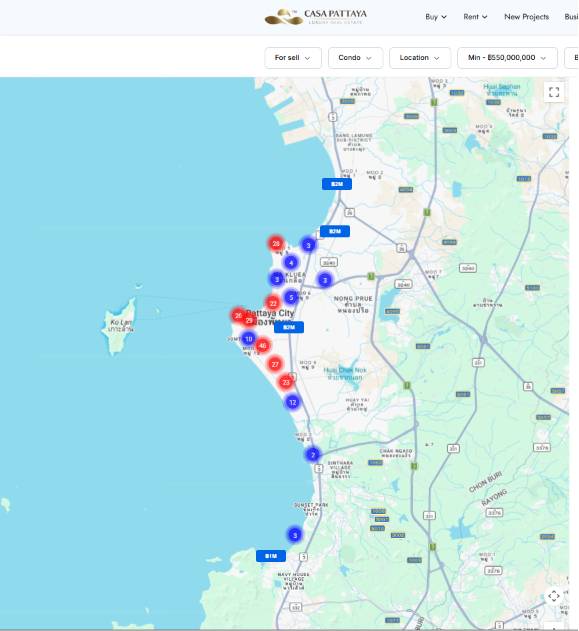
A regular business site might embed a simple map showing one office location — a nice-to-have, not a core feature. A real estate site typically needs interactive maps as a primary navigation tool: clustering pins for dozens of nearby listings, letting users draw a custom search boundary, toggling between map view and list view, and updating results dynamically as someone pans or zooms. This requires proper integration with a mapping API and careful performance work so the map doesn't choke the page when it's rendering a large number of properties at once.
Media at Volume
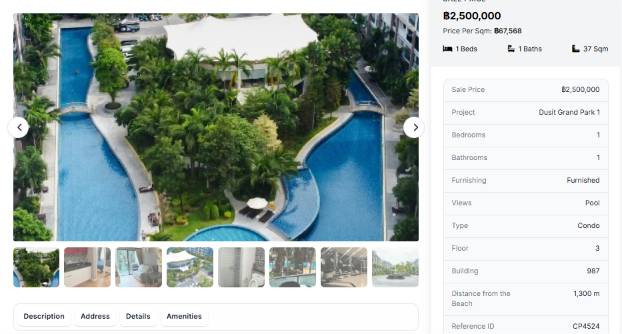
Property listings live and die on photography — and increasingly, on video walkthroughs and 3D virtual tours. A regular site might have a modest, curated set of brand images. A real estate site needs to handle potentially thousands of high-resolution photos across hundreds of listings, all optimized so the site still loads quickly. That requires deliberate image compression pipelines, lazy loading (so images only load as a visitor scrolls to them), and often a content delivery network to serve that media quickly regardless of where in the world a visitor is browsing from.
Lead Capture Built for Buyer Behavior
Regular websites usually route everyone toward one general contact form. Real estate sites perform far better with lead capture tied to specific listings and specific buyer intent — a "Schedule a Viewing" button on each property page, a "Get Notified of Similar Listings" prompt, saved search alerts that email a buyer automatically when something new matches their criteria. This isn't cosmetic; it's the difference between capturing a lead at the exact moment someone is emotionally engaged with a specific property, versus losing them to a generic contact form that doesn't reflect what they were actually looking at.
User Accounts and Saved Activity
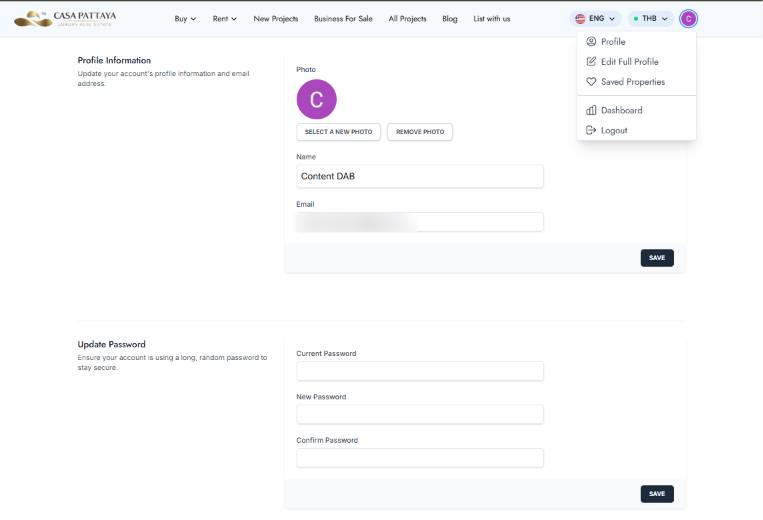
Many modern real estate platforms let buyers create an account, save favorite listings, store search criteria, and return later to a personalized dashboard. That's application-level functionality — authentication, user-specific data storage, personalized content — layered on top of what looks, superficially, like a normal website.
CMS Needs for a Sales Team, Not a Marketing Team
A regular business site's content management needs are usually modest — updating a blog post occasionally, swapping out a testimonial. A real estate brokerage often has an entire sales team who need to add and edit listings constantly, sometimes from a mobile device while out at a property. That demands a purpose-built, genuinely user-friendly back-end interface designed around how agents actually work day to day — not a generic CMS that happens to also be capable of storing property data.
SEO With a Different Shape
Regular web design SEO usually centers on a manageable set of service and content pages targeting a defined set of keywords. Real estate SEO has to account for potentially thousands of individual, dynamically generated listing pages, each of which needs proper structured data (schema markup specific to real estate listings), clean URL structures, and technical handling so search engines can crawl and index a constantly changing inventory without getting confused by outdated or duplicate listing pages. Local SEO also carries outsized weight, since so much real estate search behavior is inherently neighborhood- and location-specific.
A Comparison, Side by Side
| Factor | Regular Web Design | Real Estate Web Design |
| Content type | Mostly static pages | Large, constantly changing dataset |
| Core interface | Navigation menu, content pages | Multi-parameter search and filtering |
| Data source | Manually managed CMS content | MLS/IDX feed integration, live database |
| Maps | Optional, decorative | Core navigation and search tool |
| Media handling | Modest, curated image sets | Large volumes of photos, video, 3D tours at scale |
| Lead capture | General contact form | Listing-specific inquiries, saved search alerts |
| User accounts | Rarely needed | Common — saved listings, personalized dashboards |
| CMS complexity | Standard, general-purpose | Purpose-built for agent workflows and listing data |
| SEO structure | Defined set of content pages | Thousands of dynamically generated, schema-marked listing pages |
| Underlying skill set | Design and front-end development | Full-stack development, database architecture, API integrations |
What This Looks Like in Practice
Consider a small independent agent with a handful of active listings at any given time. In that case, a well-designed, relatively standard website — with a clean layout, strong photography, and a simple listings page manually updated every so often — may genuinely be sufficient. The scale simply doesn't demand the full weight of real estate-specific infrastructure yet, and building it prematurely would be over-engineering a problem that doesn't exist at that size.
Now consider a mid-sized brokerage managing several hundred active listings across a metro area, with a team of agents constantly adding and updating properties. At that scale, a manually managed, standard website becomes a genuine liability — listings go stale, agents waste time on manual data entry that should be automated, and buyers get frustrated by clunky or nonexistent filtering. This is exactly the kind of business where a full platform rebuild, complete with MLS integration, proper search infrastructure, and a purpose-built agent dashboard, pays for itself many times over in time saved and leads captured that would otherwise be lost.
Then consider a developer marketing a single new condominium project — one property, many units, each with its own floor plan, pricing tier, and availability status. This sits in an interesting middle ground: it doesn't need MLS integration or the scale of a multi-listing brokerage platform, but it does need real functionality most standard websites lack — an interactive unit selector, a live availability tracker as units sell, and floor-plan comparison tools — meaning it still leans heavily toward real estate-specific development rather than a purely design-led build, just at a more contained scope.
Across all three examples, the deciding factor isn't the industry label "real estate" by itself — it's the actual complexity of the data, the search behavior buyers expect, and the operational needs of the team managing it day to day.
Where Businesses Get This Wrong
Choosing a template because it "looks like" a real estate site. Plenty of website templates are visually styled for real estate — property-card layouts, a hero image of a nice home — without any of the underlying search, filtering, or MLS integration infrastructure a real estate business actually needs. A site can look the part and still be functionally a regular website underneath.
Underestimating how much MLS/IDX integration actually involves. This isn't a simple plugin install in most cases — it involves data mapping, ongoing synchronization, and often compliance with specific display rules set by the local MLS. Businesses that treat this as a minor technical detail are often surprised by how much planning and development work it actually requires.
Building for current listing volume instead of anticipated growth. A brokerage with 30 listings today that expects to have 300 within two years should be building the underlying data architecture for that scale from day one — retrofitting proper search and filtering infrastructure onto a site that was never built for it is far more disruptive and costly than planning for growth upfront.
Neglecting mobile performance on media-heavy listing pages. Buyers browsing property photos and virtual tours on their phones are extremely common, and a listings site that loads slowly or handles images poorly on mobile will lose engaged buyers at exactly the moment they're most interested.
Assuming a real estate site is "done" once it launches. Because listings change constantly, a real estate website is never really finished the way a static brochure site can be — it requires ongoing technical maintenance, MLS sync monitoring, and often continued feature development as the business's needs evolve, which is a meaningfully different long-term relationship than a design-led site typically requires.
Deciding What Your Business Actually Needs
The honest starting question isn't "do I need a real estate website" — almost every property business will answer yes to that in some form. The more useful question is: how much of my business genuinely depends on buyers being able to search, filter, and interact with a large, constantly changing set of listings, versus how much of my business is really about presenting who I am and how to get in touch?
An individual agent or small team with a manageable number of listings, limited turnover, and buyers who are comfortable with a simpler browsing experience may do perfectly well with a strong, standard, design-led website. A brokerage, developer, or property platform managing meaningful volume, frequent listing changes, and buyers who expect the kind of filtered, map-driven search experience they're used to from major real estate portals needs something built with real technical depth underneath the surface — not a template dressed up to look the part.
Getting that assessment right, before committing to a build, is what separates property businesses whose websites become genuine operational tools from the ones stuck, like the developer at the start of this article, with a site that photographed well in a pitch deck and fell apart the moment real buyers started actually using it.