


Website Migration: Why It Matters, When to Do It, and What to Expect





Website Migration: Why It Matters, When to Do It, and What to Expect
A website migration rarely makes it onto a business's list of exciting projects. It doesn't generate the kind of visible excitement a new logo or a fresh marketing campaign does, and in the short term, it mostly looks like risk — the possibility of downtime, lost search rankings, or something breaking that used to work fine. That perception is exactly why so many businesses keep postponing a migration they genuinely need, sometimes for years, even as the underlying platform holding their website together quietly becomes less and less capable of supporting the business built on top of it.
But a website migration — moving a site to a new platform, a new hosting environment, a new content management system, or a fundamentally rebuilt technical foundation — is one of the more consequential technical decisions a growing business makes, and understanding why it matters, when it's actually warranted, and what genuinely happens if it keeps getting deferred is worth far more attention than it usually gets.
What "Migration" Actually Means
Before getting into the why and when, it's worth being precise about what a migration actually involves, since the term covers a range of different scenarios.
Types of Migration
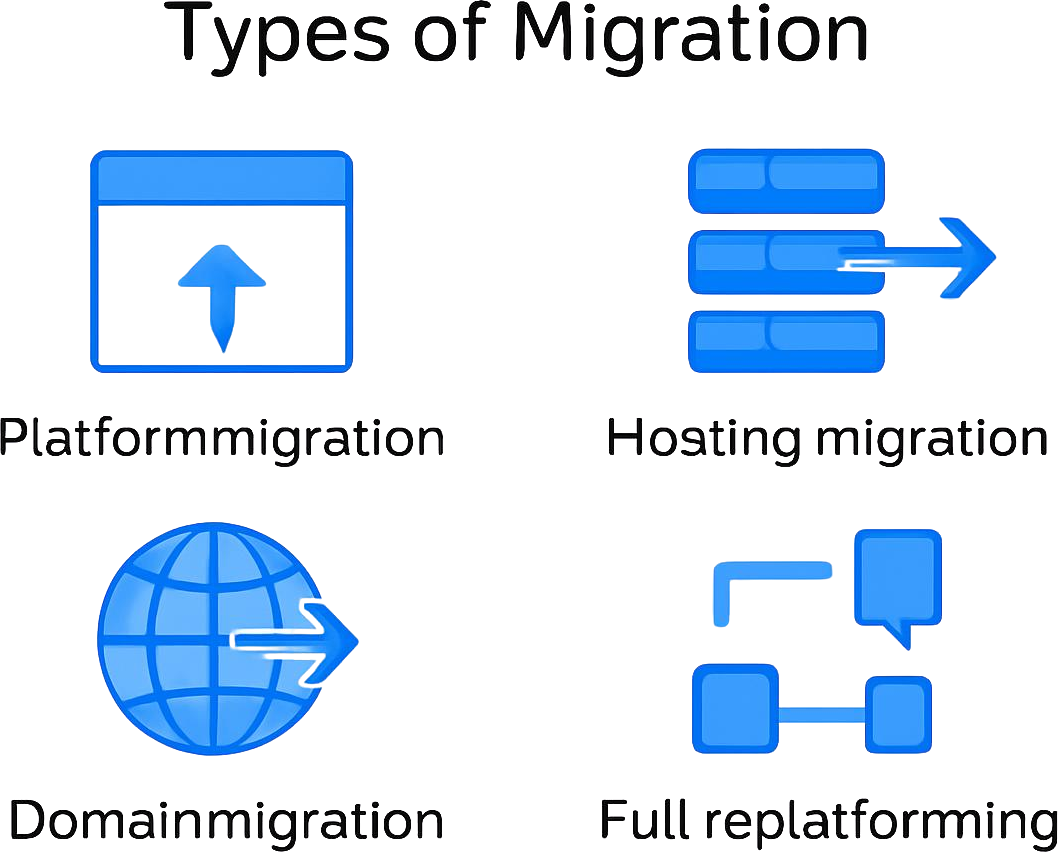
- Platform migration — moving from one content management system to another (for example, from a basic website builder to WordPress, or from WordPress to a custom-built platform).
- Hosting migration — moving a site's underlying infrastructure to a new hosting provider or server environment, often without necessarily changing the platform itself.
- Domain migration — moving content to a new domain name, which carries its own distinct set of SEO and redirect considerations.
- Technology stack migration — rebuilding the underlying codebase, often to move from an outdated framework or language to a modern one better suited to current needs.
- Full replatforming — a combination of several of the above, typically undertaken when a business has genuinely outgrown its original technical foundation across multiple dimensions simultaneously.
Each type carries different technical considerations, but they share a common thread: something about the current setup no longer adequately serves the business, and staying put has become a bigger risk than moving.
Why Businesses Migrate in the First Place
The Platform Can No Longer Support the Business's Actual Needs
This is the most fundamental reason migrations happen. A website built years ago, on a platform chosen for an earlier, smaller version of the business, often simply cannot support what the business has since grown into — more products, more complex functionality, higher traffic, or integrations the original platform was never built to handle.
A retailer that launched on a basic ecommerce platform suited to a small catalog of a few dozen products, for instance, often finds that platform struggling once the catalog grows into the thousands, once international shipping and multi-currency support become necessary, or once the business needs deeper integration with inventory and fulfillment systems the original platform was never designed to connect with.
Performance Has Degraded Below an Acceptable Standard
Slow load times, unreliable uptime, and poor mobile performance often accumulate gradually on an aging platform — sometimes because the underlying technology itself has fallen behind current standards, sometimes because years of added plugins, scripts, and content have simply outgrown what the original infrastructure was built to handle efficiently. Since page speed directly affects both user experience and search rankings, this kind of gradual performance decay is rarely just a minor inconvenience.
Security Risk Has Become Unacceptable
Older platforms, outdated software versions, and unsupported technology stacks accumulate security vulnerabilities over time, particularly once a vendor stops actively maintaining and patching a given platform version. A business running on a platform that no longer receives regular security updates is carrying meaningfully more risk than one on actively maintained, current infrastructure — and that risk compounds the longer migration gets delayed.
The Existing Site Can't Support Necessary New Functionality
Sometimes a business's needs evolve in a direction the current platform structurally can't accommodate — a growing real estate brokerage needing MLS integration and advanced search functionality, a SaaS company needing to build the actual product behind a login screen, a hospitality group needing a booking system with logic more sophisticated than a basic plugin can offer. In these cases, the platform isn't failing at its original job; the business has simply moved into territory the original platform was never built to serve.
SEO and Technical Debt Have Compounded
Years of accumulated technical shortcuts, outdated code, broken internal linking structures, and content built without proper technical SEO foundations can create a kind of technical debt that becomes increasingly difficult to fix incrementally. At a certain point, a full migration to cleaner, better-structured infrastructure becomes more efficient than continuing to patch an aging, increasingly fragile system.
The Vendor or Platform Itself Is Being Discontinued or Deprioritized
Occasionally, migration isn't optional in any real sense — a hosting provider shuts down, a platform vendor discontinues support, or a proprietary system a business depended on is sunset entirely. These forced migrations tend to be the most stressful precisely because they happen on someone else's timeline rather than the business's own.
When Migration Actually Makes Sense
Signs That Point Toward Migrating Soon
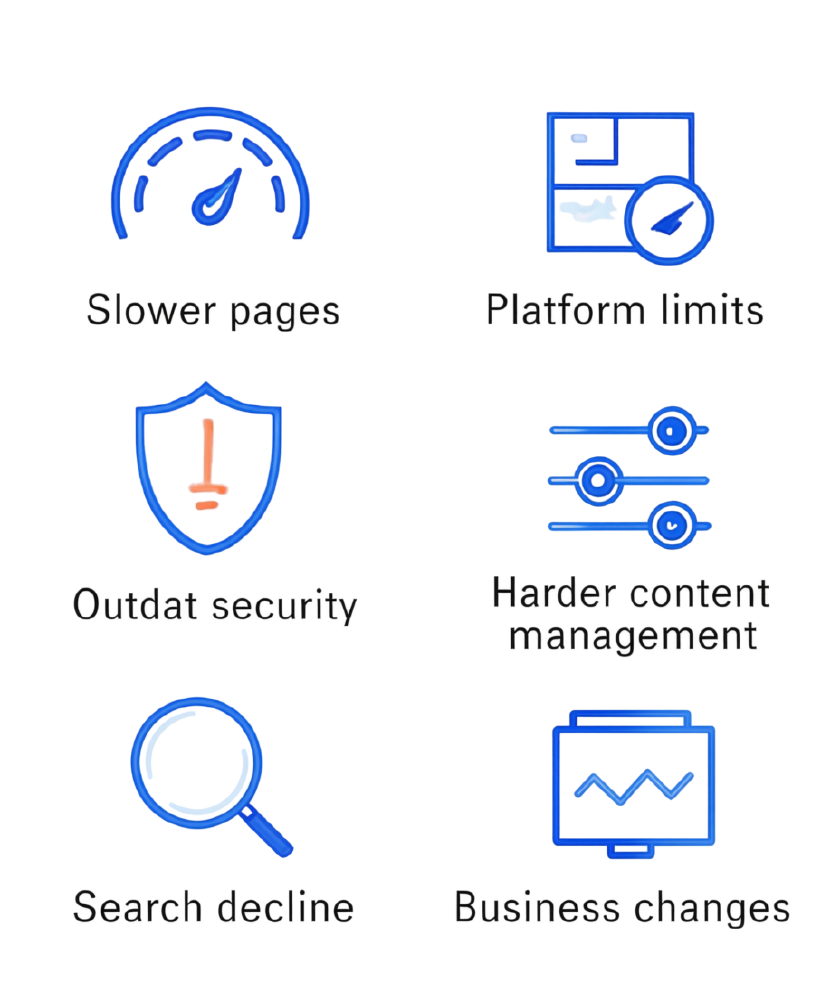
A few recurring signals tend to indicate that migration has moved from "eventually" to "genuinely due":
- Page load times have crept up noticeably and stayed there despite routine optimization efforts.
- The business has repeatedly hit functional walls — needing a feature or integration the current platform simply cannot support without an awkward workaround.
- Security patches or platform updates have become inconsistent, delayed, or have stopped altogether.
- Managing day-to-day content or operations on the current platform has become noticeably more cumbersome as the business has grown.
- Search rankings have been declining in ways that trace back to structural or technical issues rather than content quality.
- A significant business change — a rebrand, a merger, a major shift in product line or target market — has made the existing site's structure fundamentally mismatched with where the business is now.
Timing Considerations Worth Weighing Deliberately
Migration timing isn't only about whether the need exists — it's also about choosing a moment that minimizes disruption. Businesses often plan migrations around lower-traffic seasonal periods, giving the team more room to catch and fix issues before a high-traffic period arrives. A retailer, for example, would generally avoid migrating a website in the weeks immediately before a major seasonal sales period, since that's exactly when the business can least afford unexpected downtime or technical issues, and would instead plan the migration for a quieter stretch earlier in the year, with enough buffer to resolve any post-migration issues well before the busy season begins.
It's also worth timing migration around internal bandwidth — a properly executed migration requires real attention from both the technical team executing it and the business stakeholders who need to review content, test functionality, and catch anything that doesn't carry over correctly. Attempting a migration during an already stretched, busy period for the internal team tends to produce a rushed, higher-risk process.
What Genuinely Happens If a Business Doesn't Migrate
It's worth being specific here, since "you should probably migrate eventually" is easy advice to defer indefinitely without a clear sense of the actual, accumulating cost of not doing so.
Performance and User Experience Continue Eroding
Every month a business delays a needed migration on an aging, underperforming platform is another month of degraded page speed, clunkier mobile experience, and a growing gap between what the site delivers and what visitors have come to expect from faster, better-built competitor sites. This erosion tends to be gradual enough that it's easy to underestimate cumulatively, since no single week looks dramatically worse than the last.
Security Exposure Compounds
Delayed migration off an aging or unsupported platform means continuing to operate with accumulating, often increasingly well-documented vulnerabilities. The cost of a security incident — a breach, a defaced site, a period of blacklisting by browsers or search engines — is typically far higher, in both direct cost and reputational damage, than the cost of the migration that would have prevented it.
The Business Keeps Operating Around the Platform's Limitations, Not With It
Perhaps the most underappreciated cost of delayed migration is the ongoing operational drag of working around a platform's limitations rather than being properly supported by it — manual workarounds for functionality the platform can't natively handle, staff time spent on inefficient processes a modern system would automate, and missed opportunities for features or integrations that would genuinely improve the business but simply aren't achievable on the current foundation.
SEO Equity and Rankings Erode Relative to Competitors
Search engines increasingly reward sites with strong technical performance, clean structure, and modern infrastructure. A business that delays migration while competitors move to faster, better-structured platforms doesn't just stay flat in search visibility — it typically declines in relative standing as the gap between its own aging technical foundation and the improving standard set by competitors continues to widen.
The Eventual Migration Becomes Harder, Not Easier
This is one of the more counterintuitive costs of delay: the longer a business waits, the more content, functionality, and accumulated technical debt has built up on the old platform, which generally makes the eventual migration larger, more complex, and more expensive than it would have been if undertaken earlier, before that additional complexity accumulated. Businesses sometimes delay migration specifically to avoid short-term disruption, only to eventually face a significantly larger, riskier migration project than an earlier, smaller one would have required.
The Cost of Forced, Unplanned Migration
If migration is eventually forced by circumstances outside the business's control — a platform shutting down, a critical security breach, a hosting provider discontinuing service — the business loses the ability to plan the timing, budget, and execution carefully on its own terms. A forced migration under time pressure is consistently riskier and more disruptive than a deliberately planned one, since there's little room to properly test, stage, and validate the new environment before it needs to go live.
How a Well-Planned Migration Actually Reduces Risk
A properly executed migration — planned deliberately rather than delayed or forced — typically follows a structured process designed specifically to minimize the risks businesses worry about:
- Full content and data audit before migration begins, ensuring nothing important gets lost in the transition.
- Complete redirect mapping, so that every existing URL properly forwards to its new equivalent, preserving accumulated SEO equity rather than losing it in the switch.
- A staging environment where the new site is built and thoroughly tested before it ever becomes publicly visible, catching issues well before they could affect real visitors.
- A defined rollback plan, so that if something does go wrong during the actual cutover, the business can revert to the previous version with minimal disruption while issues are resolved.
- Post-migration monitoring, tracking search rankings, site performance, and functionality closely in the weeks immediately following launch, since this is typically when any overlooked issues become apparent.
A well-planned migration executed with this kind of process tends to involve a brief, carefully managed period of adjustment rather than the dramatic, extended disruption businesses often fear — the risk in migration usually comes not from the act of migrating itself, but from doing it carelessly, without proper planning, testing, and redirect handling.