


How Landing Pages Differ for a Thai Clinic, Hotel, and Real Estate





A landing page is one visit, one question, and one next step the office will still honour. The same template is often pasted onto a Thai clinic, a hotel, and a real estate project or agent. The page then answers the wrong question, asks the wrong fields, and puts the wrong proof on the first screen. This note compares those three patterns. It supports the landing-page service. How that work is scoped sits on our landing page design page. This article sets no fee, no conversion rate, and no lead volume.
Short answer: Name the vertical before the layout. A clinic page names the concern or treatment and routes a consult the desk will see. A hotel page names the property and the stay, and hands reservations a date request or a path the hotel will honour. A real estate page says project inquiry or agent lead, and keeps the public name on the request. The sibling on why real estate websites fail in Thailand diagnoses property sites. The sibling on hotel website SEO versus OTA dependence is hotel channel choice. This page is the landing pattern. It changes no live path.
What a landing page must do
Someone arrived from one promise: an ad, a message, a search, or a card. They must finish the next step that promise named. A menu of every service is a compressed homepage, not a landing page. Staff must say the same sentence the hero says. If they will not name the treatment, the stay, or the project that way, the hero is wrong. A new theme does not fix that sentence. Above the fold means the first phone screen. This page invents no fold height.
The first screen finishes the question the visit already started. Later copy may add detail a named person will stand behind. It may not open a second product. Each vertical keeps a different identifier on the request. Lose it, and the form has nowhere to go.
What the page must answer
A Thai clinic
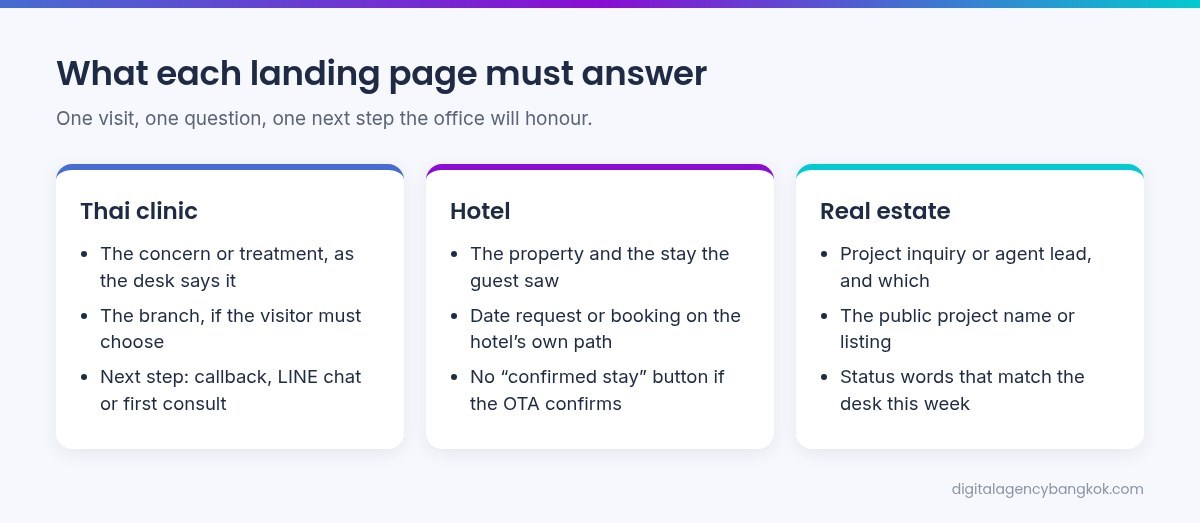
Name the concern or treatment as the desk says it, and the branch if the visitor must choose. Say the next step: a callback, a LINE chat the desk checks, or a first-consult request. Do not imply a booked procedure unless the clinician will honour it. One named concern and a general first visit are different pages. A published note on clinic website conversion covers the wider clinic site. This page quotes no figure from it.
A hotel
Name the property and the stay the guest already saw, only if reservations will say the same thing. Say whether the next step is a date request, or a booking on the hotel’s own path. If confirmation happens only on an OTA, do not label the button as a confirmed stay here. Channel choice belongs on the sibling note. A package page is not the room index.
A real estate project or agent
Say which it is. A project inquiry carries the public project name the gallery will send. An agent lead names the listing or area, and who replies. If both exist, use two labels. Status words must match the desk this week. Do not invent a unit count or a starting price. The sibling on failed property sites covers portals, duplicates, and missing routing. Do not invent a second URL from this note.
What the form asks
Ask only what the named person will use. Carry the name the page already stated. The thank-you line uses the same label as the button. One thank-you for a consult, a stay request, and a project visit means the form did not know what it collected.
Clinic fields
Ask name, phone or LINE, language, and the branch if needed. Carry the concern named here. Ask a day window only if someone will read it. Do not ask check-in, room type, guest count, a project name, or a budget slider. Do not collect a medical history unless that record already exists and the person who replies will see it. The first form is routing, not a chart.
Hotel fields
Attach the property name. Ask dates reservations can check, and a contact that desk will see. Do not ask which doctor, a symptom, a unit type, or a viewing slot. If the form cannot create a stay the hotel will honour, label it as a request, not a booking.
Real estate fields
Attach the project name or listing identifier. Ask name and phone or LINE. Use one label: visit, brochure, or agent question. Ask a budget only if the person who replies will quote from it. Do not ask check-out, treatment, or a doctor. Do not send both lead types to one unlabeled inbox. Send one phone test. Do not count it, and do not publish a lead volume.
What proof belongs above the fold
Proof lets the visitor match this page to the place they will deal with. It is not a badge, a percentage, or a stock block from another vertical. If staff would not say it aloud, it does not belong on the first screen.
Clinic proof
Show the treatment name as staff say it, and the clinic or clinician identity the visitor can match to the door or the branch. Show one next step: a consult request, or a LINE chat the desk checks. Do not put before-and-after images above the fold unless this clinic will stand behind them. Do not paste a rate strip or a countdown nobody will update.
Hotel proof
Show the property name and the stay already named, if reservations will honour it. Show a location line staff would say, and one labeled next step. Do not put a doctor portrait, a treatment menu, a unit plan, or a units-left line. Do not invent an occupancy figure. If the only proof is an OTA logo, say confirmation happens off this domain. Do not dress that logo as the hotel’s own booking.
Real estate proof
Show the public project name, or the listing or area the office will send, and who the page is from: the gallery, or a named agent. Show one next step with the right label. Do not put a medical identity block, a hotel package strip, or a booking calendar. Do not invent a sales rate, a traffic figure, or a lead count. A map of projects the company will not discuss is leftover theme, not proof. This article carries no image.
What must not be copied
A copied template fails more often than a missing plugin. The hero question, the first-screen proof, and the form fields travel together. Do not move them as a set.
Do not copy a clinic consult onto a hotel page. Which doctor and a treatment menu answer a medical visit. Do not copy a hotel booking onto a clinic or a project. Check-in, room type, and book a stay answer a reservation. If the only working button leaves for an OTA or a portal, write that internally. It is the company’s next step only if the request still reaches someone named.
Do not copy a listing search onto a clinic or a hotel. Bedroom count, a phase filter, and an agent grid answer property inventory. A licence line is clinic identity. A name the company will send is real-estate proof. A stay reservations will honour is hotel proof. The same sentence on all three pages is a claim none can stand behind. A Thai and English pair is a language pair if staff honour both. Do not change a live slug, and do not invent a redirect.
A check before reuse
- Name the vertical. If real estate, name project or agent. If both, two labels.
- Write the sentence the visit already started. The hero answers that sentence, not the menu.
- List proof for this vertical only. Remove the other vertical’s badges.
- List fields the named person will use. Drop hotel fields from a clinic form, clinic fields from a hotel form, and both from a project form that needs a name and the public name.
- Name who sees the request. On a phone, one labeled next step is reachable, and the identifier is still attached after a test. Do not count the test.
- If the page is also the homepage, the room index, or the treatment menu, split it or stop calling it a landing page.
Hand a landing-page team that sentence, the fields to omit, and who sees the request. They may wire the form so the named person sees the identifier. They may not invent a rate or a lead volume, or paste the clinic form onto the hotel page. A scoped conversation belongs on landing page design. This note does not replace that page and does not edit it.
A clinic page that still says book your stay, a hotel page that still asks which doctor, and a project page that still asks for a check-out date are the same mistake. Fix the sentence, the proof, and the form before you add a widget. Property diagnosis is on why real estate websites fail in Thailand. Hotel channel choice is on hotel website SEO versus OTA dependence. Scope sits on landing page design. This page quotes no price and reports no conversion rate or lead count. It links no hotel, clinic, or real estate service page.
FAQ
Can one landing page serve a clinic, a hotel, and a project?
No. Shared chrome is fine. A shared hero, proof block, and form are not. Each vertical keeps its own identifier and next step.
What should sit above the fold?
The name staff will say, the proof that vertical uses, and one labeled next step. Not a rate or another vertical’s badge. This page sets no pixel height for the fold.
Which fields should the form omit?
Omit hotel dates and room type on a clinic or project page. Omit treatment and doctor on a hotel or project page. Omit bedroom count and a budget slider the desk will not use. Ask a budget on real estate only if the person who replies will quote from it.
Only if a named person checks it and the request keeps the identifier. LINE, a published mobile, and the form are three paths until someone writes which one is the record.
Where is the price, and how is this different from the sibling notes?
Not here. This page sets no fee, conversion rate, traffic figure, or lead volume. The real estate sibling diagnoses why property sites fail. The hotel sibling is website SEO versus OTA dependence. A scoped quote belongs on the landing page design page.