


SEO Mistakes That Can Push Your Website Down Google




SEO Mistakes That Can Push Your Website Down Google
Search Engine Optimisation (SEO) is the practice of improving a website so it becomes more visible in search results — and, increasingly, more visible to AI-driven answer tools like Google AI Overviews, ChatGPT, and Perplexity. Done well, SEO helps the right people find your content, product, or service at the exact moment they're searching for it. Done poorly, it can quietly work against you, and many websites lose traffic without ever understanding why.
This article explains what SEO actually involves today, breaks down the most common mistakes that hurt rankings, and shows what to do instead — with a quick-reference table you can use as a checklist.
What Is SEO, and Why Does It Matter More Than Ever?
At its core, SEO is about helping search engines understand what your content is, who it's for, and why it deserves to be shown to someone with a specific question or need. Historically, this meant optimizing for keywords and building backlinks. Today, search engines evaluate a much broader set of signals: content quality and depth, user experience, technical performance, topical authority, and how trustworthy and well-structured a page is.
The stakes have also changed. Search results are no longer just a list of blue links. AI Overviews, chat-based assistants, and generative answer engines now summarize, synthesize, and directly cite content instead of simply linking to it. A page that ranks on page one but isn't structured clearly may still be skipped over by an AI tool looking for a direct, quotable answer. This means SEO today isn't just about ranking — it's about being genuinely useful enough that both search engines and AI systems choose to surface and cite your content.
The Most Common SEO Mistakes That Hurt Rankings
Most ranking problems aren't caused by one dramatic error. They're usually the result of a handful of quiet, compounding mistakes that build up over months. Below are the ones that show up most often — across small business websites, blogs, and large content-driven sites alike.
Writing for Keywords Instead of People
Stuffing a page with a target keyword, or forcing awkward variations of it into every heading, used to be a shortcut to ranking. Search engines are now far better at detecting content that's built around a phrase rather than around a real answer. The result is content that reads unnaturally and fails to hold a reader's attention — both of which are negative signals.
Ignoring Search Intent
Every search query has an intent behind it — a person wants to learn something, compare options, or take an action. Publishing a sales page for a query that's actually informational (or a shallow blog post for a query that needs an in-depth guide) creates a mismatch. Even if the page briefly ranks, users leave quickly, and search engines treat that as a signal the content isn't a good match.
Publishing Thin or Repetitive Content
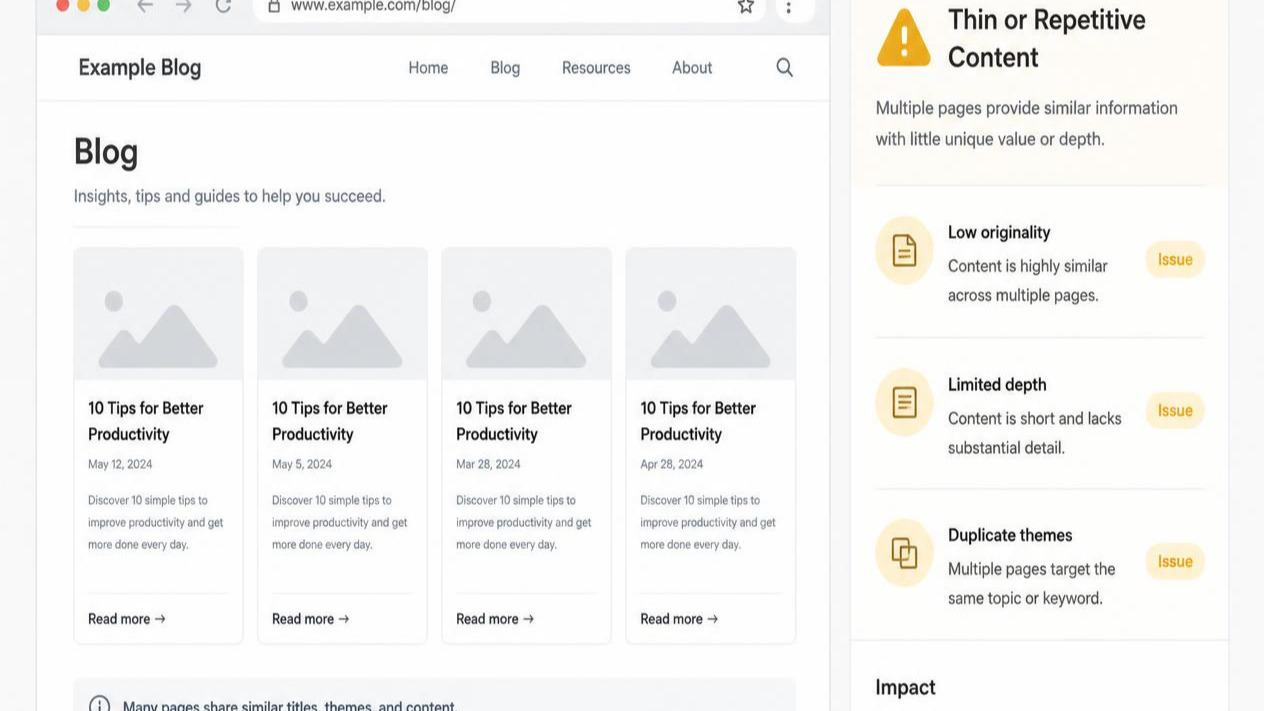
Content depth matters more than content volume. A short page that skims the surface of a topic, or a large batch of near-identical pages published just to "cover more keywords," rarely performs well. Search engines and AI retrieval systems increasingly favor pages that answer a question completely and add genuine value beyond what's already available elsewhere.
Neglecting Technical SEO
Even excellent content won't rank if search engines can't properly crawl, index, or understand your site. Broken links, incorrect robots.txt rules, duplicated or missing meta tags, and poor URL structures quietly block growth — often without any obvious warning sign.
Slow Page Speed and Poor Mobile Experience
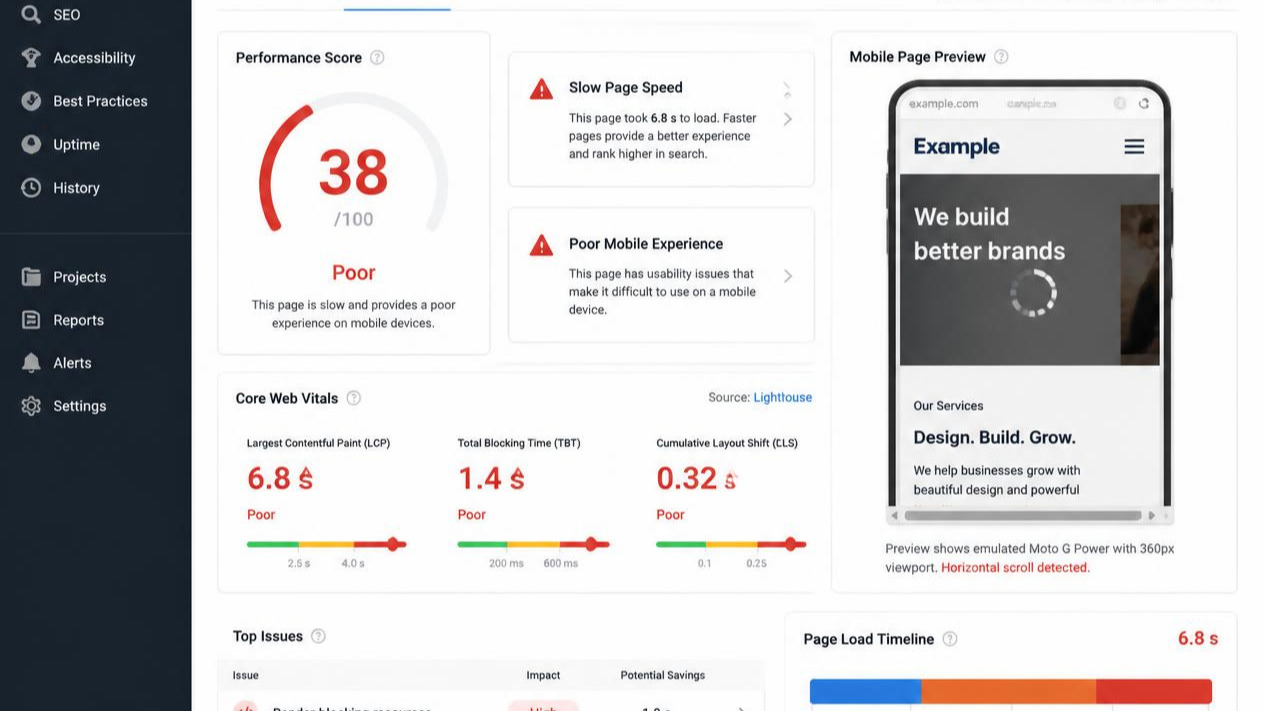
Most searches now happen on mobile devices, and page speed (measured through Core Web Vitals) is a direct ranking factor. Heavy uncompressed images, excessive scripts, and cluttered mobile layouts increase bounce rates and reduce engagement — both of which work against your rankings.
Weak or Non-Existent Internal Linking
Internal links help search engines understand how pages on your site relate to each other, and they help users navigate naturally. Common mistakes include orphan pages with no internal links pointing to them, generic anchor text like "click here," and relying solely on menus or footers instead of linking contextually within content.
Low-Quality or Risky Backlinks
Backlinks still signal authority, but quality matters far more than quantity. Buying links, using private link networks, or acquiring links from unrelated, low-quality sites can actively damage trust rather than build it. A small number of relevant, earned links from credible sources outperforms a large volume of spammy ones.
Duplicate or Near-Duplicate Content
When multiple pages on a site cover almost the same topic with little differentiation, search engines struggle to determine which one should rank — often weakening both instead of boosting either. This is especially common with template-based pages that aren't given unique structure or context.
Ignoring Structured Data (Schema Markup)
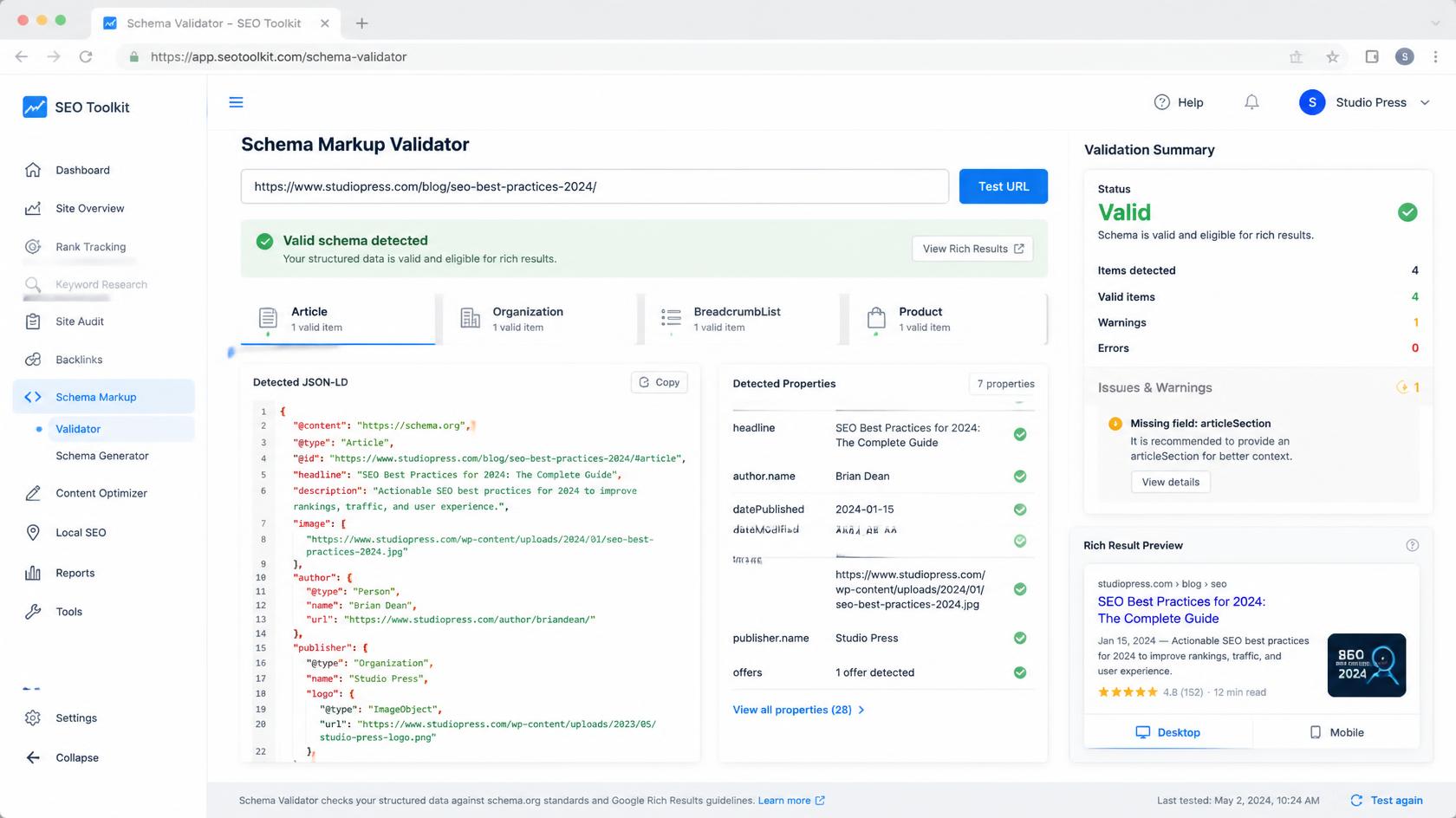
Structured data doesn't guarantee higher rankings on its own, but it helps search engines and AI tools understand your content more precisely — which improves the odds of appearing in rich results, featured snippets, and AI-generated answers. Missing, incorrect, or outdated schema markup is a frequently overlooked technical gap.
Treating SEO as a One-Time Project
SEO is not something you set up once and forget. Search algorithms update regularly, competitors are actively working on their own visibility, and content that isn't refreshed gradually loses relevance and rankings. Businesses that treat SEO as ongoing maintenance consistently outperform those that treat it as a single fix.
SEO Mistakes at a Glance
| Mistake | Why It Hurts Rankings | What to Do Instead |
| Keyword stuffing | Creates unnatural, robotic content that reduces trust and readability | Use related terms naturally; write for the reader first, keywords second |
| Ignoring search intent | Content briefly ranks but fails to satisfy the searcher, causing quick exits | Match content format (guide, comparison, product page) to what the query actually needs |
| Thin or repetitive content | Signals low value; fails to satisfy AI and search engine "information gain" checks | Publish fewer, deeper pages that fully answer the topic |
| Neglected technical SEO | Search engines can't properly crawl, index, or understand the site | Run regular technical audits; fix broken links, tags, and indexing issues |
| Slow speed / poor mobile UX | Increases bounce rate; directly impacts Core Web Vitals ranking signals | Compress images, reduce scripts, test real mobile performance |
| Weak internal linking | Isolates important pages and dilutes authority across the site | Link contextually within content using descriptive anchor text |
| Low-quality backlinks | Erodes trust signals instead of building authority | Earn links through genuine outreach, partnerships, and valuable content |
| Duplicate content | Confuses search engines about which page should rank | Give every page unique structure, angle, and context |
| Missing structured data | Reduces eligibility for rich results and AI citations | Implement and validate relevant schema (Article, FAQ, Product, etc.) |
| Treating SEO as one-time | Rankings erode as algorithms and competitors move forward | Review, refresh, and measure performance on an ongoing basis |
How to Structure Content So It Performs Well Across SEO, AEO, and GEO
Traditional SEO, Answer Engine Optimisation (AEO), and Generative Engine Optimisation (GEO) all reward slightly different things, but they overlap more than they conflict:
- For SEO, use clear heading structure (a single H1, logical H2/H3 hierarchy), descriptive titles and meta descriptions, and natural keyword usage tied to real search intent.
- For AEO, write direct, self-contained answers to specific questions — ideally within the first sentence or two of a section — so search engines can lift them into featured snippets or voice results.
- For GEO, focus on depth, originality, and clarity, since generative AI tools tend to cite sources that provide complete, well-organized, and trustworthy information rather than shallow or duplicated content.
In practice, this means every well-structured, genuinely useful page tends to perform reasonably well across all three — because all three ultimately reward content that clearly and completely answers a real question.